When Canon announced the replacement to my much-used Canon 24-70
f/2.8 L there were more than a few disappointments. Many potential
buyers were hoping to see the inclusion of Image Stabilization (IS) to
this lens (something being added to even some non-L series primes like
the recent 24 & 28mm f/2.8′s), they also saw a front filter element
size increase (to 82mm… seems like 82 is the new 77) and a substantial
increase in price to around $2,499. Having purchased the 24-70 f/2.8 L
version 1 for around $1,100 a few years earlier, I didn’t initially see
the value-add that it could possibly bring.
When the opportunity arose to work with and review the new lens
along-side my version one I accepted. Why not? Users had been reporting
that it was incredibly sharp, and while the version one isn’t known as
being the sharpest L lens in the lineup, it is a lens I use nearly daily
in my work, even if it’s not particularly sharp, but does sharper make
the new lens better?

Canon EF 24-70 f/2.8L II at 24mm, 70mm and front view – Click for larger
My original reason for investing in the Canon 24-70 lens was to have a
multi-purpose zoom lens that offered a fairly shallow depth of field, a
good working distance at events and weddings, and made for good
portraits. The later point working a bit better on a crop body sensor,
as 70mm a full frame can fall a bit short on a lot of portrait
assignments.
I’ve never found it a particularly “fun” lens – just functional. Like
a reliable car, it got me to where I needed to go, worked hard and
well, and never gave me any problems. Because of this, I didn’t expect
to like the 24-70 f/2.8 L II and because of it’s cost, I didn’t want to
like it.

“Lee” | Canon EF 24-70 f/2.8L II | Click for Larger
Build
It was easy to see the changes they made to the 24-70 f/2.8 L
II – immediately noticeable were the thicker zoom and focus rings. This
makes for a smoother working interface for the still-image shooter, but
is even more useful for people in the video world using pull-focus and
other rigs that require a larger grip. The zoom mechanism *might*
opperate a bit more firmly and smooth than its’ predecessor, but it’s
more likely that my version one has seen better days and is a little
loose from wear. Both 24-70′s, when using the zoom function, extend and
contract, while the version one was fully extended at 24mm, they’ve
reversed that on version two with 24mm fully retracted and 70mm fully
extended. They’ve also included a lock-switch at 24mm to prevent the
barrel from accidentally extending, which I’ve never needed before and
haven’t had any issues with the version 2. Seeing as 82mm is becoming
the new norm in high quality glass, it’s time to upgrade your filter
collection if you have one. I don’t use UV filters myself, but A
circular polarizer is a must on a lot of my shoots, that’s a cost bullet
I’d already bitten this year with the Canon TS-E 24mm f/3.5 L II.
While the Version two doesn’t seem to weigh much more than the one,
it does feel smaller, in large part due to the new petal shaped lens
hood which takes up far less space on and especially reversed.
This new hood clips onto the front lens element, and extends in and
out with the lens. I actually didn’t notice this much on my version one,
because the lens hood (which was significantly larger) attached to the
outer barrel of the camera, essentially hiding the protruding front
element.
Image
Sadly, for my wallet, it was also easy to see the differences
in the new optics too. Where the Canon 24-70 f/2.8 L Version one was
fairly soft at the edges and unimpressively flat in colour and contrast,
the 24-70 f/2.8 L II is sharp at the centre and only slightly less at
the edges while producing full, rich colours and tones. When I showed a
friend an image straight out of camera he remarked on how the “feel” was
more like the Canon 24mm f/1.4 L II; a lens many buy for it’s contrast
and colour. The folks over at lensrentals.com even mentioned that, in
their tests, centre sharpness was as good as the Canon TS-E 24mm f/3.5
II L – a bold claim considering it’s the sharpest 24mm I’ve ever used.

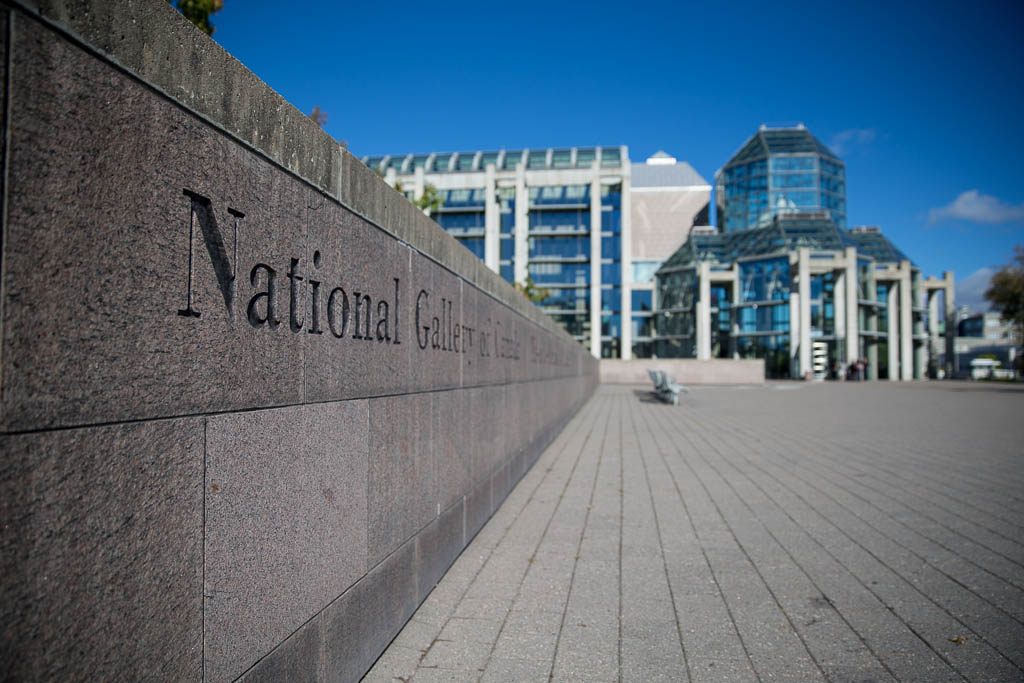
National Gallery in Ottawa, Canada | Canon EF 24-70 f/2.8L II – Click for Larger
At 24mm f/2.8 there is certainly a bit of vignetting and distortion,
both of which can be corrected in post-production. It’s also noticeably
sharp, which only improves as you stop the aperture down. It’s amazing
what a quality boost will do for your enjoyment of the optics. I found
myself re-exploring the entire focal range. Of course it’s uses are
still the same as before, but the results are just that much better.

Fun with flare | Canon EF 24-70 f/2.8L II – Click for Larger
Another thing to note is that they’ve added an aperture blade (9, up
from 8 in the version one), when rounded, this can create smoother
bokeh, and 18-point starbursts from specular highlights. A good lens to
me stands up in tough conditions, and one of those is shooting directly
into your light source. I found the Canon 24-70 f/2.8 L II handled
itself better than most, and produced some great contrasty images other,
lesser, lenses would have completely blown out.

Spencer | Canon EF 24-70 f/2.8L II – Click for Larger
Uses
I originally purchased the 24-70 to help me shoot events, which
on a full frame body is great for capturing small groups of people in a
tight environment, or zooming in slightly to get a two person portrait,
it’s a bit wide for really tight and compressed portraits, but the
50-70mm range is still quite good for it.. On a 7D, Rebel, or 60D body,
24mm is an effective crop resulting in 38mm and the 70mm range
effectively results in 112mm making it a ideal portrait lens, especially
at f/2.8. Wedding shooters or anyone else trying to capture flash-free
images in low light will appreciate the f/2.8 aperture, and the
versatile zoom range, perfectly paired with one of Canon’s many 70-200mm
offerings, will give a dual-wielding shooter effective dominion over
any photographic situation. As you can see from many of my photos,
capturing your children is a great way to use this kind of zoom. I know
several family portrait photographers who built their careers on a 5D
and 24-70 f/2.8 Lens.

Portrait | Canon EF 24-70 f/2.8L II – Click for Larger
I still don’t find the 24-70 zoom to be my most creatively inspiring
lens, but it is my most useful, and having it sharper gives me new-found
confidence in it’s capabilities and allows me to put it to uses I may
not have assigned to it in the past, in favour of potentially higher
quality prime glass. Undoubtedly the 24-70 f/2.8 L II is one of Canon’s
most versatile lenses, for amateurs or pro’s alike. Though at the time
of this writing, it’s also the most expensive 24-70 lens on the market,
and that kind of price creep is hard to justify if you’re not making
serious money off your gear. As a tool of the trade, however, if you
want the best, this is undoubtedly it, and you’ll be using it for many
years to come.
Pro’s
- Versatile multi-purpose zoom
- Fast consistent f2.8 aperture
- Sharp
- Colour & contrast rendition as good as some primes
Cons
- Twice as expensive as its predicessor
- More expensive than any other 24-70 currently on the market
- Did I mention cost?
- 82mm thread, but this is the last time I’ll say it’s a setback: Let’s get used to it okay?
CR’s Take
The EF 24-70 f/2.8L was one of Canon’s top 3 most popular
lenses for the last decade. It seems every bag, of every professional
photographer that shot Canon, had this lens in their arsenal. The focal
range seems to hit a nerve with a lot of full frame shooters. For all
the praise the lens received, there were still things that bothered
people about version 1.
Is it better than Version 1?
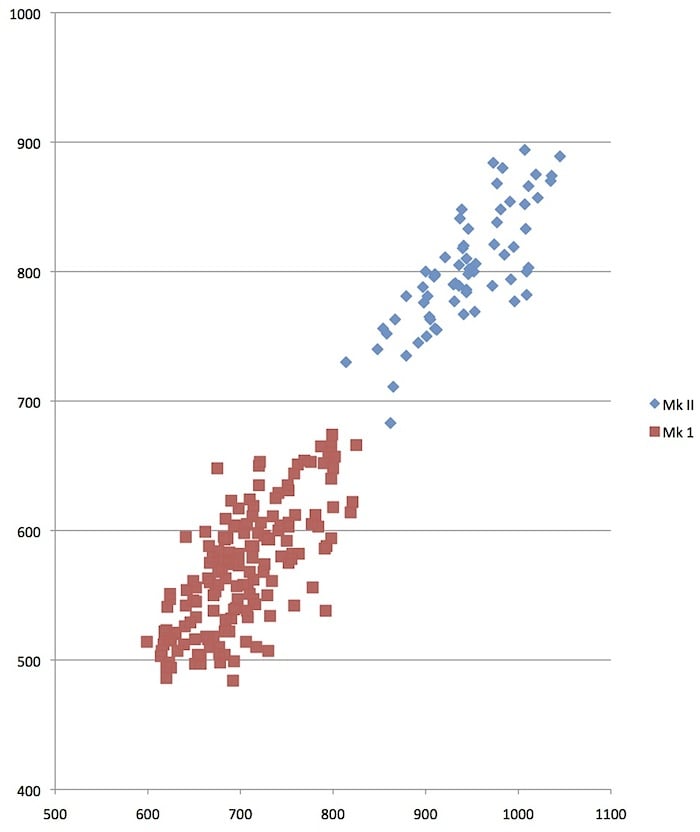
One thing that bothered people was the perceived variance in
copy sharpness, which after a lot of testing on the web proved to be
true. We now have microadjustment in the camera bodies that can offset
some of that, however it doesn’t always fix the issue. This lens has
always needed constant calibration in our rental fleet, and I’ve heard
other rental houses saying the same thing. Would version 2 improve on
that? It appears overall sharpness has definitely increased, however
copy variance still exists. The good news, the worst 24-70 f/2.8L II is
still better than the best of the version 1 crop according to the chart
below. The bad news is this lens will still probably require some
microadjustment on your part to get the best performance with your
bodies. Always remember camera bodies can play a part in copy variance
too.

Copy Variation | Red = Version 1 | Blue = Version 2 | From LensRentals.com – Click for Larger
Read the article about copy variance at LensRentals.com
A few other things people didn’t like about version 1 was the weight
and bulk of the lens. People had mixed opinions on the lens hood design
and the fact the lens was at 24mm when extended. This is generally
reverse of any other lens out there. If you were using it for landscape
and had it at the widest angle, there was sometimes balance issues on
small tripods.
Version 2 addresses the size, weight and where the extended zoom sits
at 24mm. I much prefer it this way, although some people are critical
of how the lens looks with the new hood design. I’m not one of those
people, as I think the balance is far better now. It doesn’t have what I
thought to be an “oversized” feeling of the previous version. The hood
was huge!
Based on teardowns, the EF 24-70 f/2.8L II should also be more
reliable. The weak parts of the previous version have been improved and
the lens should stay calibrated far better. We also expect that the zoom
ring will get stuck less, as this has plagued some of the version 1′s
in our rental fleet.
Bigger filter?
The 82mm filter thread is what it is, buying new filters is always
expensive and somewhat annoying when you have a fleet of 77mm filters.
If you don’t have any filters, 82mm is a good place to start, as you can
use step down rings for 77mm and below. I’d recommend a thin polarizer
with this lens if you plan to use step downs on small and wider lenses.
The Price
This is the second biggest complaint I hear about this lens, as $2299 is
a significant investment. The previous version launched at $2100 over a
decade ago, so this one is actually cheaper at launch of we correct for
inflation. I realize that doesn’t make you feel better, but at least we
know the trajectory for pricing on this lens will be in our favour. I
don’t expect to see price drops for about 12 months. Once the initial
demand is met, we’ll probably see this lens on rebate programs. It’d be
nice to see this lens bundled with a 5D Mark III eventually to help
offset some cost. I don’t expect that to happen though.
Where is the IS?
I think I have to answer this question at least 10 times a week
(and I’m happy to do so). I think IS was omitted to help with size and
weight, as making this lens lighter was a big goal at Canon. I think we
also have to consider that people shooting with a 5D Mark III or EOS-1D X
at events may not need IS, as they can shoot ISO 6400 and get great
results. I know that isn’t a good enough reason for a lot of people,
it’s just all I can come up with. Will we see an IS version of this lens
in future? I’d say it’s possible, but it’ll cost a ton and may not be
around for a long while.
I personally don’t mind the omission of the IS in this lens if it helps keep it lighter and smaller.
Conclusion
All-in-all, this is a worthy upgrade of a pretty classic lens.
Is it $1000 better than the previous version? No, I don’t think it is.
When it starts to fall below $2000 in a year or so, I think it’s a good
value lens. If you’re budget minded, go grab yourself a used version 1
and be happy, it’s still a great lens. If you want the best 24-70 on the
market and don’t mind paying for the privilege, you won’t be
disappointed with the EF 24-70 f/2.8L II.
http://www.canonrumors.com