sabato 16 giugno 2012

Sigma 18-250mm F3.5-6.3 DC Macro OS HSM

News image
The Sigma 18-250mm F3.5-6.3 DC Macro OS HSM is a new, compact superzoom lens for dSLR cameras with APS-C sized sensors. Compared to the existing 18-250mm F3.5-6.3 DC OS HSM, the new lens offers a lighter and more compact design, better close-up capabilities with a maximum magnification ratio of 1:2.9, and incorporates a special Thermally Stable Composite (TSC) material that makes it ideal for use in circumstances where extreme variations in temperature cannot be avoided. The Sigma 18-250mm F3.5-6.3 DC Macro OS HSM lens is also equipped with Super Multi-Layer Coating to reduce flare and ghosting, a Hyper Sonic Motor (HSM) to ensure fast and quiet auto-focusing, an Optical Stabiliser (OS) for better hand-held results and a rounded, seven-blade diaphragm for a pleasant rendering of the out of focus areas. The lens will be available in Sigma, Sony, Nikon, Canon and Pentax mounts, starting with the Canon version coming in July. Pricing and availability for other mounts have yet to be announced.
Update: Sigma Japan has posted 16 sample photos taken with this lens.
Sigma Press Release
Sigma Corporation of America announces new 18-250mm F3.5-6.3 DC Macro OS HSM lens
New Thermally Stable Composite material offers wide range of photography in compact, stabilized, macro lens


Ronkonkoma, NY, June 15, 2012 – Sigma Corporation of America, a leading researcher, developer, manufacturer and service provider of some of the world’s most impressive lines oflenses, cameras and flashes, is pleased to announce the availability of its new Sigma 18-250mm F3.5-6.3 DC Macro OS HSM lens starting in July 2012. Pricing is still pending.

The addition of the 18-250mm F3.5-6.3 DC Macro OS HSM speaks to Sigma’s versatile product lineup with this multipurpose zoom lens that offers Optical Stabilization (OS)* and covers wide angle to telephoto to macro photography. It differs from Sigma’s current 18-250mm F3.5-6.3 DC OS HSM lens with its even more compact size, its macro capability with a maximum magnification ratio of 1:2.9 and the use of Thermally Stable Composite (TSC) material currently used only by Sigma.

TSC, which is incorporated into the lens barrel and is often compared to polycarbonate, has a high degree of elasticity and exhibits little variation in its structure in extreme temperature conditions. This means that internal barrel expansion and contraction due to extreme temperature variations is less prevalent. TSC also contributes to the lens’ size reduction. The non-macro 18-250mm F3.5-6.3 without TSC weighs 22.2 ounces and is 3.1 by 4 inches in diameter, whereas the new macro lens is 16.6 ounces and 2.9 by 3.5 inches in diameter.

“We’re constantly trying to improve and expand our lens lineup, and this addition is no exception,” said Mark Amir-Hamzeh, president of Sigma Corporation of America. “By redesigning the lens and adding TSC, we are able to offer this very compact, feature-rich lens that is flexible enough to tackle a range of photography, including landscape, sport and macro. This is key for the everyday photographer who wants to travel light but pack the punch of a complete camera bag.”

Sigma optimized this lens’ power arrangement by incorporating double-sided aspherical lenses and reexamining the design to achieve a more compact filter diameter. The lens has an approximate 13x high zoom ratio with a filter size of 2.8 inches in diameter. Sigma’s unique OS system, as well as one Special Low Dispersion (SLD) glass and three aspherical lens glasses, compensate for camera shake and enable correction of color aberration, respectively.

The new 18-250mm F3.5-6.3 DC Macro OS HSM lens is also equipped with Super Multi-Layer Coating to reduce flare and ghosting, a Hyper Sonic Motor (HSM) to ensure fast and quiet auto-focusing, and a rounded, seven-blade diaphragm to create an attractive round blur to the out of focus areas. The lens features a brass-made bayonet mount applied on the surface to reinforce strength for long-term use and enable high accuracy and solidity.

This lens will be available in Sigma, Sony, Nikon, Canon and Pentax mounts, starting with Canon mounts coming in July, 2012. Pricing and all availability for other mounts have yet to be announced.

To locate an authorized Sigma dealer nearest to you, visit http://www.sigmaphoto.com/where-to-buy-sigma. For information about Sigma Corporation of America, visit http://www.sigmaphoto.com.

*Sony and Pentax mounts are not incorporated with OS function.

About Sigma Corporation
For more than 50 years, Sigma Corporation’s expertise and innovation has driven the company’s core philosophy of “knowledge, plus experience, plus imagination,” with an emphasis on producing high-quality, high-performance photographic technology at moderate prices. This family-owned organization is the largest, independent SLR lens manufacturer in the world, producing more than 40 lenses that are compatible with most manufacturers, including Sigma, Canon, Sony, Nikon, Olympus, Panasonic and Pentax. Sigma Corporation also produces digital SLR cameras and high-definition digital compact cameras. The company is headquartered in Japan, with offices strategically located throughout Europe, Asia and North America. For information, please visit http://www.sigmaphoto.com.

venerdì 15 giugno 2012

Nikon D600 Leaked Photos


Nikon D600
Some leaked photos of the upcoming Nikon D600 have surfaced online at a Chinese forum.  The D600 is rumored to be a 24MP FX-format DSLR that will be situated at a much lower price point than the higher-end D800.
More images and specs below.
Nikon D600
Nikon D600

Nikon D600 Rumored Specifications

  • 24.7MP full frame sensor
  • Weight: 760g (850g with battery and memory cards), the D800 weights 900g
  • 3.2″ LCD with 921K dot with ambient sensor control
  • HDMI output
  • Video compression: H264/MPEG-4
  • Full HD with 30p, 25p, 24p, HD with 60p, 50p, 30p, 25p
  • Viewfinder coverage: 100% for FX , 97% for Dx
  • Built-in AF motor
  • Probably weather sealed
  • No built-in GPS as initially reported
  • ISO range: 100-6400 (with Lo-1 ISO 50 and Hi-2 ISO 25,600)
  • 39 AF points (with an option of 11 AF points), 9 cross-type AF points
  • AF face detection
  • Exposure compensation: ±5 EV (same as the D800)
  • The D600 will probably use the EN-EL15 rechargeable Li-ion battery
[via Nikon Rumors]

Odds & Ends: 70D, 7D2, New Full Frame, D600 & Photoshop CS6

Odds & Ends: 70D, 7D2, New Full Frame, D600 & Photoshop CS6
Lots of small things
The rumor mill has started to heat up as of late, most of the stuff seems pretty out there. However, stuff is appearing on other sites and in my inbox. I’m not sure how much of it is recycled speculation, but that does happen from time to time.
I’ll rate each bit of information on its own.
3 new DSLR bodies this summer [CR1]
A mention of 3 new EOS bodies before Photokina in September. Only one of them being a full frame camera. It was suggested that an “entry level” full frame camera wouldn’t be announced and it would be an upper level EOS-1D style camera.
7D Mark II to be full frame? [CR1]
I’ve seen this in my inbox a few times, and it has shown up on [cw]. I’ve never really believed this one, I don’t think they can call it “7D Mark II” and change the sensor size from a marketing perspective. There are lots of EF-S lenses in the hands of 7D owners.
I have no doubt there will be a full frame camera under the 5D Mark III, but it can’t have all the prosumer features of the 7D to retain the moniker and stay around $2000. That just doesn’t seem like smart marketing. But hey, I’m not in marketing. :)
Canon EOS 70D [CR1]
More mentions of the 70D moving up the ranks in the APS-C realm and becoming the flagship APS-C camera. We’ve heard similar things and think it’s entirely plausible.
Adobe Photoshop CS6 Review
We have posted Ben Long’s review of the Adobe’s latest version of Photoshop, Read it here.
Nikon D600
The speculated “entry level” full frame Nikon D600 looks to be quite real. Check the photo evidence here.

Via: http://www.canonrumors.com/

Arca Swiss RotaMount

News image
Arca Swiss has announced the RotaMount, a brand new rotating back designed for use with the Arca Swiss R-Series as well as with F and M Line view cameras. Allowing users to switch seamlessly from landscape to portrait format in just a couple of seconds, this safe and secure system guarantees total flexibility, the company says. The RotaMount is available for €390.
Press Release
ARCA-SWISS is extending and completing its range of accessories for its leading-edge R-series cameras.
The ARCA SWISS RotaMount is a brand new rotating back designed for use with the ARCA SWISS R-Series (digital or film back) as well as with F and M Line view cameras. The new RotaMount back allows you to switch seamlessly from landscape to portrait format in just a couple of seconds. This safe and secure system guarantees total flexibility. The unparalleled ARCA SWISS VariFind R-series variable focal length optical viewfinder has now been further enhanced with the addition of masks that can be shifted independently on both X and Y axes. The viewer can be used in landscape and portrait modes. The viewerʼs bright and high contrast display transmits light through small holes in the viewer mask to show the applied shift.
A superb viewfinder for professionals.
RotaMount : 390 €
VariFind : 950 €

Total Production of Nikkor Lenses Reaches Seventy Million

News image
Nikon today announced that total production of Nikkor lenses for interchangeable lens cameras has reached seventy million. As the 60 millionth Nikkor was manufactured in April 2011, this means that Nikon produced no less than 10 million interchangeable lenses in a matter if just 14 months. Additionally, the company has reached another milestone by producing the 30 millionth lens equipped with a Silent Wave Motor (SWM).
Nikon Press Release
Total Production of NIKKOR Lenses Reaches Seventy Million
Amsterdam, The Netherlands, 14th June 2012 Nikon today announced that total production of NIKKOR lenses for interchangeable lens cameras reached seventy million at the beginning of June 2012. The figure is up five million since production reached sixty five million in October 2011. Moreover, total production of AF-S lenses equipped with the Silent Wave Motor (SWM), the autofocus motor developed by Nikon, has reached 30 million.
Since 2011 and the 65 million milestone, Nikon has continued to actively develop new products under the NIKKOR brand and has released four 1 NIKKOR lenses with a simple design in various colours for the compact and lightweight Nikon 1 J1 and Nikon 1 V1 AC-IL system cameras – the first two models in the Nikon 1 series. In addition, Nikon launched new FX-format compatible NIKKOR lenses that maximize the potential of high-performance cameras such as the new D4 flagship D-SLR camera, and the 36.3 million pixel D800 and D800E D-SLRs.

Thirty million SWM-equipped NIKKOR lenses
The Silent Wave Motor, or SWM, is an ultrasonic autofocus motor developed by Nikon. Nikon’s SWM converts ‘traveling waves’ into rotational energy to focus the optics. This enables extremely smooth, quiet and comfortable autofocusing. Among the first lenses for which Nikon adopted the SWM was the Ai AF-S NIKKOR 300mm f/2.8D IF-ED, released in 1996. Since then, the SWM has been built into a total of 58* different lenses of all types, from ultra-wide-angle to super telephoto DX- and FX-format lenses, zoom lenses, and even Micro lenses. It has been adopted for more than 90% of NIKKOR lenses currently manufactured.
*The total number of NIKKOR lenses equipped with the SWM currently available (as of June 14, 2012).

The NIKKOR brand
As the brand name for Nikon lenses, NIKKOR has become synonymous with high-performance, high-quality SLR lenses. The NIKKOR name comes from adding “R”, a common practice in the naming of photographic lenses at the time the name was established, to “Nikko”, the Romanized abbreviation for Nippon Kogaku K.K. In 1933, the large-format lens for aerial photography was released with the name Aero-NIKKOR.
NIKKOR has always been ahead of the times. The OP Fisheye-NIKKOR 10mm f/5.6 fisheye lens for SLR cameras, released in 1968, was the world’s first lens to incorporate aspherical lens elements. What’s more, NIKKOR lenses for the latest SLR cameras utilize a number of Nikon’s own cutting-edge technologies, including Nano Crystal Coat, which virtually eliminates internal lens element reflections across a wide range of wavelengths.
The current line-up of NIKKOR lenses for Nikon SLR and Nikon 1 system cameras offers a rich variety of lenses, including fisheye lenses, super wide-angle to super telephoto lenses, micro lenses and PC-E lenses.

Nikon AF-S Nikkor 24-85mm f/3.5-4.5G ED VR

News image
Nikon has announced a new FX-format zoom lens with a 24-85mm focal range, compact build and Vibration Reduction. Weighing in at 465 grams, the Nikon AF-S Nikkor 24-85mm f/3.5-4.5G ED VR features an inner focusing mechanism, with autofocus controlled by a Silent Wave Motor (SWM). The optical formula comprises 16 elements in 11 groups, including 1 ED and 3 aspherical lens elements. The minimum focus distance is 38cm from the focal plane at all focal lengths. Also featuring an iris diaphragm with 7 rounded blades for a pleasing bokeh, the AF-S Nikkor 24-85mm f/3.5-4.5G ED VR takes 72mm filters and comes with an HB-63 lens hood and a CL-1118 soft pouch as standard. Available from the end of this month, the new Nikon 24-85mm VR lens can be yours for £519.99/$599.95.
Nikon Press Release
Amsterdam, the Netherlands, 14th June 2012 Nikon today announces a new FX-format zoom lens with broad 24-85mm focal range, compact build and Vibration Reduction. With a versatile reach from wide-angle up to telephoto and a lightweight body, it’s a smart choice for FX camera users looking for a multi-purpose lens that doesn’t cut any corners when it comes to image quality.
Zurab Kiknadze, Product Manager, Lenses, Accessories & Software, Nikon Europe, says: “The idea behind this lens was to combine a useful focal range with a compact yet sturdy build, but without sacrificing the image quality modern Nikon D-SLRs require. It strengthens Nikon’s range of affordable and versatile FX-format zoom NIKKOR lenses, and is a smart choice for Nikon shooters looking for a practical way to cover a variety of situations.”

Multi-tasker
Developed to be especially compact for an FX-format zoom lens, this 24-85mm NIKKOR is ideal for people who want a walkabout lens that offers the freedom to shoot a wide variety of day-to-day moments and subjects. The versatile 24-85mm range covers most commonly used focal lengths with ease: from landscapes to portraits, you can go fairly wide or zoom into distant objects without needing to change lenses.

Sharp and Steady
Complementing the versatile focal range is Nikon’s second-generation Vibration Reduction technology (VRII) — that allows substantially sharper handheld images across the zoom range and dramatically reduces image blur, especially when shooting towards the telephoto end of the range. VRII also enables you to shoot using shutter speeds up to four stops slower, enabling you to shoot more effectively when shooting in low light.
Nikon’s Super Integrated Coating ensures superb color reproduction, while Extra-Low Dispersion (ED) glass and three aspherical lens elements help deliver stunning sharpness and contrast, even at maximum aperture.

Good to Go
Well-balanced in terms of size, weight, price and image quality — and boasting a weather-sealed mount — this lens offers a worthwhile combination of precision NIKKOR optics, broad focal range and lightweight build for people on the go.
This lens comes with a lens case CL-1118 and hood HB-63.

Nikon AF-S DX Nikkor 18-300mm f/3.5-5.6G ED VR

News image
The Nikon AF-S Nikkor 18-300mm f/3.5-5.6G ED VR is a new DX-format lens with an ultra-high 16.7x zoom ratio and a 27-450mm equivalent focal range. Complementing the versatile focal range is Nikon’s second-generation Vibration Reduction system, which is claimed to allow “substantially sharper handheld images across the zoom range.” The optical formula comprises 19 elements in 14 groups, including 3 aspherical and 3 ED lens elements. Offering a 45cm close-focus point at the 300mm setting, the Nikon AF-S DX Nikkor 18-300mm f/3.5-5.6G ED VR provides a maximum reproduction ratio of 1:3.2. An iris diaphragm with 9 rounded blades allows for a smooth rendering of the out-of-focus areas. Weighing in at 830 grams, the new Nikon 18-300mm lens comes with a CL-1120 soft pouch and a petal-shaped HB-58 hood. With availability slated for the end of June, the DX Nikkor 18-300mm f/3.5-5.6G ED VR is expected to retail at around £850/$1000.
(Note that unlike the also-new AF-S Nikkor 24-85mm f/3.5-4.5G ED VR, the 18-300mm f/3.5-5.6G ED VR is a DX lens whose imaging circle does not cover the full FX frame.)
Nikon Press Release
AF-S DX NIKKOR 18-300mm f/3.5-5.6G ED VR - One for All
Amsterdam, The Netherlands, 14 June 2012 – Nikon today announces a new high-powered DX-format zoom lens with wide-angle to super-telephoto reach and Vibration Reduction. Boasting an ultra-high 16.7x zoom ratio and incredibly wide 18-300mm focal range, this new lens is a great all-rounder for photographers with a broad range of interests.
Zurab Kiknadze, Product Manager Lenses, Accessories & Software, Nikon Europe says: “The great thing about the new 18-300mm DX lens is that you can head for a day out shooting without carrying a bag full of gear. Photographers who like to travel light won’t have to compromise on what they shoot because its remarkable zoom range covers most situations with ease.”

All in One

With its versatile wide-angle to super-telephoto reach, this 16.7x zoom lens is perfect for travel or for times when you only want to take one lens out with you. The remarkable 18-300mm focal range (FX-format/35mm equivalent: 27 to 450mm) easily covers most commonly used focal lengths, going further than many comparable lenses by offering 300mm reach and a maximum aperture of f/5.6 at the telephoto end of the range. From wide landscapes to tight portraits and action photography, this lens will capture it all.

Sharp and steady

Complementing the versatile focal range is Nikon’s second-generation Vibration Reduction system (VRII) — that allows substantially sharper handheld images across the zoom range and dramatically reduces image blur, even when taking extreme telephoto shots. Three Extra-Low Dispersion (ED) glass and three aspherical lens elements provide high resolution and superior contrast, and the nine blade rounded diaphragm opening makes out-of-focus elements blend together smoothly. Nikon’s compact Silent Wave Motor technology (SWM) combines fast and precise auto focus with super-quiet operation.

Built to travel

A practical zoom-lock switch keeps the lens secure when not in use, and it boasts a metal mount with rubber sealing for protection against dust and moisture.
This lens comes with a lens case CL-1120 and hood HB-58.

Schneider Kreuznach Enters CSC Lens Market

News image
Schneider Kreuznach has announced its intention to enter the lucrative market of Compact System Camera lenses. “We are placing a strong focus on the innovative market for mirrorless system cameras with their interchangeable lenses and have appropriate developments in the pipeline,” said Schneider Group’s managing director Dr. Josef Staub. “Schneider Kreuznach will launch the first lens of an all-new range of mirrorless system cameras this fall.” According to Photoscala the first lens in the line-up, called the Schneider Kreuznach Super Angulon 2,0/14mm, will be available with a Micro Four Thirds mount for “less than 1500 euros.” Unusually for a Schneider Kreuznach lens, the Super Angulon 14mm f/2 will offer auto focus capabilities as well as diaphragm control via the camera body.
Press Release
SCHNEIDER KREUZNACH enters market for system camera lenses
With sales at prior-year levels, Schneider Kreuznach records increase in profit. Industrial business shows high potential.  New product range for system cameras in pipeline.  Positive outlook for current year.
BAD KREUZNACH, June 14, 2012. Jos. Schneider Optische Werke GmbH based in Bad Kreuznach, Germany, and its subsidiaries have recorded an increase in operating results by around 14 %. Total sales of 85.5 million euros in 2011 were roughly at prior-year level. Continual growth at the company’s Bad Kreuznach headquarters contributed 51.7 million euros to Group sales, up 6 percent versus the prior-year period. “We have been making major investments at the Bad Kreuznach location and are pleased to see that the headquarters has recorded further growth,” said Schneider Group’s managing director Dr. Josef Staub.
Particularly the growing demand in the Automotive sector for highprecision test and measurement technology plus the overall Inspection market, for instance in the field of LCD and solar production, account for significant increases in the Industrial segment which the company expects to show continuing growth potential. The simple compact cameras business on the other hand is declining. “This does not come as a surprise. We are placing a strong focus on the innovative market for mirrorless system cameras with their interchangeable lenses and have appropriate developments in the pipeline,” Dr. Staub added. SchneiderKreuznach will launch the first lens of an all-new range of mirrorless system cameras this fall. To develop and produce these high-end lenses the company is planning additional capital expenditures at the Bad Kreuznach location. In the wide range of the Consumer market, the group has already been active with B+W filters. In addition, the portfolio was enhanced by lens attachments for Apple’s iPhone last year.
About the Schneider Group:
The Schneider Group specializes in developing and producing high-performance photographic lenses, cinema projection lenses as well as industrial optics and precision mechanics. The group consists of Jos. Schneider Optische Werke, founded in Bad Kreuznach in 1913, and its subsidiaries Pentacon (Dresden), ISK Optics (Göttingen), Schneider-Optics (New York, Los Angeles), Schneider Bando (Seoul), Schneider Asia Pacific (Hong Kong) and Schneider Optical Technologies (Shenzhen). The company’s main brand is “Schneider-Kreuznach”. The group has around 660 employees worldwide, with 360 based at its German headquarters, and has been a world market leader in the field of highperformance lenses for many years.

martedì 12 giugno 2012

Novità Apple: nuovo Macbook Pro Retina Display

 http://files.petapixel.com/assets/uploads/2012/06/nextgenmbp_mini.jpg

Apple, tutte le novità del WWDC 2012, il primo senza Steve Jobs: iOS 6 con Apple Maps e l'assistente vocale Siri in italiano, il nuovo MacBook Pro Next Generation con Retina Display, i nuovi MacBook Pro e MacBook Air. Presentato ufficialmente Mountain Lion, aggiornamento di OS X. Niente iPad Mini e nessun aggiornamento per iMac, Mac mini, Apple Tv e iPhone: arriveranno probabilmente in autunno

Il primo WWDC senza Steve Jobs si è tenuto ieri 11 giugno a San Francisco: il nuovo ceo Tim Cook ha aperto la presentazione di Apple, un Keynote iniziato con un paio di stoccate indirette ai competitors storici, Google e Samsung. Poi è arrivata l'ora delle presentazioni, ecco le principali novità:

MacBook Air: rinnovati, sempre 11'' e 13'',  processore Ivy Bridge (da 3,2GHz), fino a 8GB di RAM e fino a 512MB di storage Flash; USB 2 e USB 3 in dotazione standard: chi si aspettava il Retina Display rimarrà deluso.
MacBook Pro: rinnovati i portatili da 15'', ma soprattutto MacBook Pro Next Generation, sottilissimo, pesa poco meno di due chilogrammi e ha uno schermo Retina strabiliante: per dimostrarlo mostrano un passaggio di gioco a Diablo III; probabilmente questo portatile sarà il nuovo "oggetto dei desideri" dei fan della Mela il prezzo è 2200 dollari;
Mountain Lion, la nuova versione del sistema operativo Mac OS X, viene presentata ufficialmente: uscirà a luglio e costerà 19,99 dollari. 200 nuove features, tra cui la sincronizzazione iCloud, arrivano i Messages come su mobile, le note e i reminders. I documenti d'ora in poi si sincronizzeranno "on the cloud", ovvero in automatico su iPad, iPhone e Mac usando Pages e le altre applicazioni della suite iWork di Apple; inoltre arriva, in puro stile iOS, il Notification Center. Inoltre è stato inserito un sistema di dettatura automatica (ma non è Siri). Ottima l'interazione con Twitter e rinnovato il browser Safari. E per chi gioca c'è il multiplayer tra tutte le piattaforme;
Siri sulle auto: Siri verrà integrato con appositi tasti al volante. Tra i partner: Chrysler, Bmw, Mercedes, Honda, Audi, Toyota e Jaguar.
iOS 6, con Siri finalmente in italiano e disponibile anche per iPad! L'assistente vocale sempre più performante e "istruito": ora sa anche i risultati delle partite di baseball (ma è solo un esempio) e riesce anche a twittare; Facebook sarà integrato come già accade con Twitter; Facetime sarà utilizzabile anche su rete cellulare come succede già con Skype; su Safari sarà finalmente possibile fare l'upload di foto. E il photo stream diventa "social". Miglioramenti anche nella app Mail con la creazione di liste "vip" e altre finezze. Viene presentata anche Passbook, la app integrata che raccoglie appunto tutti i pass: tra gli esempi, Starbucks, le carte d'imbarco, i biglietti del cinema...
Come ci si aspettava, saranno integrate le nuove Maps di Apple che andranno a sostituire quelle di Google, con tanto di navigatore, integrazione con Siri, Flyover e mappe 3D.


---------
NEL DETTAGLIO
Mountain Lion
Apple ha annunciato oggi che OS X Mountain Lion, la nona importante release del sistema operativo desktop più evoluto al mondo, sarà disponibile a luglio come download dal Mac App Store. Mountain Lion introduce oltre 200 funzioni innovative come la nuovissima app Messages, Notification Center, Sharing a livello di sistema, integrazione con Facebook*, Dictation, Power Nap, AirPlay Mirroring, Game Center e la sicurezza potenziata di Gatekeeper. Grazie a iCloud, integrato nelle fondamenta stesse di OS X, con Mountain Lion è ancora più facile tenere tutti i contenuti sincronizzati su tutti i propri dispositivi.

"Il ritmo con cui il Mac si rinnova è incredibile; OS X Mountain Lion arriva ad appena un anno dal riuscitissimo lancio di Lion," ha dichiarato Philip Schiller, Senior Vice President Worldwide Marketing di Apple. "Con iCloud integrato e le nuove funzioni Notification Center,  Messages, Dictation, integrazione con Facebook e molto altro, questo è il miglior OS X di sempre."

Utilizzando il proprio account iCloud, Mountain Lion facilita più che mai la configurazione della propria Mail, Contacts, Calendar, Messages, Reminders e Notes. Le nuove app Promemoria e Note aiutano gli utenti a ricordare gli appuntamenti importanti o a prendere rapidamente appunti, mentre iCloud tiene tutto sempre aggiornato. Documenti nella nuvola funziona con le app compatibili con iCloud, come la suite iWork di Apple, per consentire agli utenti di accedere e modificare i propri documenti su qualsiasi dispositivo.

La nuova app Messages sostituisce iChat e porta tutta l'innovazione di iMessage sul Mac: ora si possono inviare messaggi a qualsiasi iPhone, iPad, iPod touch o Mac. Si possono mandare anche allegati, come foto in alta risoluzione e video HD, e i messaggi appaiono su tutti i dispositivi, così si può tenere il filo della conversazione su tutti quanti. iMessage include messaggi di gruppo, notifiche di consegna e di lettura, indicatori di digitazione e codifica end-to-end sicura. L'app Messaggi supporta anche i servizi di instant messaging tradizionali, inclusi AIM, Yahoo!, Google Talk e Jabber.
Con Mountain Lion, le notifiche appaiono in maniera più chiara, e grazie a Notification Center, tutti gli avvisi di OS X e app di terze parti appaiono tutti comodamente in un unico posto. Si può personalizzare la scelta delle app da cui si desidera ricevere notifiche, il tipo di notifica che si vuole ricevere e il numero delle voci da visualizzare in Notification Center. E se ci si vuole concentrare sul lavoro o guardare un film, si puo' scegliere di sospendere temporaneamente tutte le notifiche.

La nuova funzione Sharing a livello di sistema è integrata in Mountain Lion, così è ancora più facile condividere link, foto, video e altri file. Cliccare sul pulsante Condividi permette all'utente di condividere velocemente senza dover passare ad un'altra app; basta accedere una volta per usare servizi di terze parti come Facebook, Twitter, Flickr e Vimeo. Facebook e Twitter sono integrati in Notification Center così che l'utente puo' ricevere una notifica quando qualcuno gli manda un messaggio all'utente o lo cita in un post o in un Tweet.

Grazie al supporto integrato per Facebook, si possono pubblicare foto, link e commenti completi di indicazioni geografiche direttamente dalle proprie app. Basta accedere una volta per vedere tutti gli amici di Facebook automaticamente inclusi nei Contacs, con tanto di foto del profilo. Le notifiche di Facebook funzionano alla grande con Notification Center di Mountain Lion, e non solo: direttamente da Notification Center si può persino aggiornare lo stato di Facebook.

Dettatura è un'altra funzione integrata in Mountain Lion e permette agli utenti di dettare ovunque si possa digitare il testo, sia che si tratti di un'app di Apple o creata da uno sviluppatore di terze parti. Mountain Lion introduce anche Power Nap, un'innovativa funzione che tiene aggiornato il MacBook Pro con display Retina e il MacBook Air (seconda e terza generazione) anche quando è in stop. Power Nap aggiorna in automatico Mail, Contacs, Calendar, Reminders, Note, Streaming foto, Trova il mio Mac e Documenti nella nuvola, e quando il Mac è collegato, scarica gli aggiornamenti software e fa il backup del computer con Time Machine.

La nuova, rivoluzionaria funzione Gatekeeper mette il computer al riparo da potenziali minacce quando si scarica software da internet dando all'utente il pieno controllo su quali app possono essere installate sul proprio Mac. Si può scegliere di installare app da qualsiasi fonte, come accade oggi, o impostare Gatekeeper affinché accetti unicamente le app dal Mac App Store per la massima sicurezza. L'impostazione predefinita consente di installare app dal Mac App Store e app create da sviluppatori con un Developer ID univoco fornito da Apple. Oltre a verificare giornalmente la presenza di aggiornamenti di sicurezza, Mountain Lion include il sandboxing delle app, per evitare che app dal comportamento anomalo compromettano l'intero sistema, e kernel ASLR per una protezione superiore contro gli attacchi di overflow del buffer.

Altre novità introdotte da Mountain Lion includono:

• AirPlay Mirroring, per trasferire in wireless con uno streaming sicuro fino a 1080p i contenuti del Mac su una televisore HD tramite Apple TV, o per inviare audio a un ricevitore o ad altoparlanti con AirPlay;
• Game Center, che porta sul Mac il famosissimo network di gioco di iOS e offre a tutti un divertimento assicurato con giochi multiplayer con gli amici, sia che stiano usando un Mac, iPhone, iPad o iPod touch;
• un browser Safari più veloce con un Campo di Ricerca intelligente unificato, tab iCloud dove appaiono i tab aperti su tutti i dispositivi dell'utente, e una nuova Vista Tab, per passare rapidamente da una all'altra;
• nuove funzioni per la Cina, come un'immissione del testo notevolmente migliorata, un nuovo dizionario cinese, facile setup dei più comuni provider di posta, ricerca con Baidu in Safari, condivisione integrata su Sina Weibo e i popolari siti di contenuti video Youku e Tudou;
• Oltre 1700 nuove API con cui gli sviluppatori possono accedere alle più recenti tecnologie web e core OS, oltre alle ultime funzioni di OS X, come Documenti nella nuvola, Notifiche, Condivisione e Game Center.

Prezzi e Disponibilità
OS X Mountain Lion sarà disponibile a luglio dal Mac App Store per $19.99 (US)**. Mountain Lion richiede Lion o Snow Leopard (OS X v10.6.8 o successiva), 2GB di memoria e 8GB di spazio disponibile. Per una lista completa dei requisiti di sistema e sistemi compatibili, si prega di visitare: apple.com/osx/specs/. OS X Server richiede Mountain Lion e sarà disponibile a luglio dal Mac App Store per $19.99 (US). L'aggiornamento OS X Mountain Lion Up-to-Date è disponibile a nessun costo aggiuntivo attraverso il Mac App Store a tutti i clienti che hanno acquistato un nuovo computer Mac che ha diritto all'aggiornamento da Apple o presso un Rivenditore Autorizzato Apple l'11 giugno 2012 o in data successiva.

*L'integrazione con Facebook sarà disponibile in un prossimo aggiornamento software di Mountain Lion.

**Prezzi locali disponibili in prossimità del lancio.


MacBook Pro "Next Generation" con Retina Display
Apple ha svelato oggi il nuovissimo MacBook Pro 15 pollici dotato dello splendido display Retina, archiviazione completamente flash e processori quad-core in un design incredibilmente sottile e leggero. Con uno spessore di appena 1,8 cm e un peso di soli 2,02 kg, il MacBook Pro, completamente riprogettato, fissa un nuovo standard in termini di prestazioni e portabilità per gli utenti professionali.
"Il MacBook Pro con display Retina raggiunge livelli di prestazioni e portabilità mai toccati prima da nessun altro notebook," ha dichiarato Tim Cook, CEO di Apple. "Con uno splendido display Retina, un'architettura completamente flash e un design incredibilmente sottile e leggero, il nuovo MacBook Pro è il Mac più evoluto che abbiamo mai realizzato."

Con i suoi oltre 5 milioni di pixel, 3 milioni in più di un televisore HD, il display Retina del nuovo MacBook Pro è lo schermo dalla risoluzione più alta al mondo mai visto su un notebook. Con una densità di 220 pixel per pollice, il display Retina ha una densità così elevata che l'occhio umano non è in grado di distinguere i singoli pixel da una normale distanza, così testo e grafica appaiono incredibilmente nitidi. Il display Retina si avvale inoltre della tecnologia IPS per un angolo di visualizzazione di ben 178° e ha il 75 percento di riflesso in meno e il 29 percento di contrasto in più rispetto alla generazione precedente.

Grazie al guscio unibody ad alta precisione in alluminio e all'architettura di archiviazione completamente in flash, il nuovo MacBook Pro è il MacBook Pro più leggero di sempre ed è sottile quasi come il MacBook Air. L'archiviazione flash è fino a quattro volte più veloce dei dischi rigidi tradizionali utilizzati nei notebook e consente al nuovo MacBook Pro di riprodurre quattro stream simultanei di video HD 1080p non compresso dall'archiviazione interna.* L'architettura di archiviazione flash offre inoltre una maggiore affidabilità, una reattività instant-on e un tempo di stanby di 30 giorni.

Il MacBook Pro con display Retina ha i più recenti processori quad-core Intel Core i7 fino a 2,7GHz con velocità Turbo Boost fino a 3,7GHz, grafica discreta NVIDIA GeForce GT 650M, fino a 16GB di RAM ultraveloce a 1600MHz e archiviazione flash fino a 768GB. Le due porte Thunderbolt e le due porte USB 3.0 consentono agli utenti professionali di collegare display multipli e dispositivi ad alte prestazioni, mentre la nuova porta HDMI offre una rapida connettività ai televisori HD.

La batteria del MacBook Pro offre fino a 7 ore di produttività wireless e si avvale di un'evoluta composizione chimica e della tecnologia Adaptive Charging per garantire fino a 1000 ricariche.** Il MacBook Pro include inoltre una telecamera FaceTime HD, un trackpad Multi-Touch in vetro, una tastiera retroilluminata di dimensioni regolari, due microfoni, altoparlanti ottimizzati, Wi-Fi 802.11n 3-stream e una porta di alimentazione MagSafe 2 più sottile.

OS X Lion, iPhoto, iMovie, iTunes e altre app Apple fra cui Aperture e Final Cut Pro X sono stati aggiornati per sfruttare al meglio il nuovo MacBook Pro con display Retina. Il nuovo Aperture 3.3 aggiornato offre inoltre rivoluzionarie funzioni di regolazione dell'immagine e supporta ora una libreria fotografica unificata, che permette ai professionisti del settore di passare facilmente da iPhoto ad Aperture e viceversa.

Il nuovo MacBook Pro include di serie OS X Lion. A partire da oggi, i clienti che acquistano un Mac avranno diritto a una copia gratuita di OS X Mountain Lion non appena sarà disponibile. Mountain Lion introduce funzioni innovative come la nuovissima app Messaggi, Centro Notifiche, Condivisione a livello di sistema, AirPlay Mirroring, Game Center e la sicurezza potenziata garantita da Gatekeeper. Grazie a iCloud, integrato nelle fondamenta stesse di OS X, con Mountain Lion è ancora più facile tenere tutti i contenuti sincronizzati su tutti i propri dispositivi.

Prezzi e Disponibilità
Il MacBook Pro 15 pollici con display Retina è disponibile attraverso l'Apple Store Online (www.apple.com/it), gli Apple Store e i Rivenditori Autorizzati Apple.  Il MacBook Pro 15" è disponibile con processore quad-core Intel Core i7 a 2.3 GHz con velocità Turbo Boost fino a 3.3 GHz, 8GB di memoria e 256GB di storage flash a partire da €2.299 IVA e tasse incluse (€1.898,10 IVA e tasse escluse); e con processore quad-core Intel Core i7 a 2.6 GHz con velocità Turbo Boost fino a 3.6 GHz, 8GB di memoria e 512GB di storage flash a partire da €2.929 IVA e tasse incluse (€2.418,76 IVA e tasse escluse). Opzioni di configurazioni disponibili al momento dell'ordine includono processori quad-core più veloci fino a 2.7GHz, fino a 16GB di memoria e storage flash fino a 768GB.

Ulteriori specifiche tecniche, opzioni CTO (configure-to-order) e accessori sono disponibili online su apple.com/macbook-pro.

*Test condotti da Apple a giugno 2012 utilizzando configurazioni di MacBook Pro in pre-produzione. Per ulteriori informazioni: apple.com/macbook-pro/features/.

**Il test sul protocollo Wireless Web è stato effettuato da Apple a giugno 2012 utilizzando configurazioni di MacBook Pro in pre-produzione. La durata della batteria e il numero dei clicli di ricarica variano a seconda dell'utilizzo e delle impostazioni. Per ulteriori informazioni: apple.com/macbook-pro/features/.

Via:  http://www.gqitalia.it

New Compact Bowens Flash Heads Ship with Built-In Radio Triggering

News image
CT Distribution is set to launch a new flash head range to its Bowens Hallmark dealer network across the UK. The multi award-winning Gemini range now includes new 200Rx and 400Rx units, and provides built-in radio triggering for the first time in the company’s compact, lightweight models. “Until now the built-in radio triggering option has only been available in the Gemini Classic, Gemini R and Gemini Pro ranges, via an optional plug-in Pulsar radio receiver card,” says Robert Cook, Bowens’ marketing director. “Now we have introduced this option in our compact and lightweight 200Ws and 400Ws models - plus, we’ve gone one step better and integrated the Pulsar radio receiver right in to the circuitry to ensure the most reliable connection. The two units can be triggered via the ‘Gear of the Year’ award-winning Pulsar Tx Transmitter, mounted on the user’s camera.” The new Gemini Rx models are available as individual units or as a bundled lighting kit, which includes a Pulsar Tx radio transmitter, lighting stands, softboxes and a newly designed rolling kit case. Pricing for the kits starts from £799.
Bowens Press Release
New compact Bowens flash heads ship with built-in radio triggering
Photographic distributor CT Distribution is set to launch a groundbreaking new flash head range to its Bowens Hallmark dealer network nationwide.
The multi award-winning Gemini range now includes new 200Rx and 400Rx units, dubbed ‘the most versatile monolights on the market today’ - and provides built-in radio triggering for the first time in the company’s compact, lightweight models.
Robert Cook, Bowens’ marketing director said: “Until now the built-in radio triggering option has only been available in the Gemini Classic, Gemini R and Gemini Pro ranges, via an optional plug-in Pulsar radio receiver card. Now we have introduced this option in our compact and lightweight 200Ws and 400Ws models - plus, we’ve gone one step better and integrated the Pulsar radio receiver right in to the circuitry to ensure the most reliable connection. The two units can be triggered via the ‘Gear of the Year’ award-winning Pulsar Tx Transmitter, mounted on the user’s camera.”
He added: “This added functionality, coupled with the ability of the entire Gemini range to be powered via mains or battery, makes Gemini Rx units the most versatile monolights available today.”
Terry Caws, national sales manager at CT Distribution said: “The original Gemini 400 model has proved itself to be one of the most popular pieces of equipment on the market – and these new units offer photographers optimal wireless creative freedom in lightweight units. The built-in radio receiver is easily controlled via a simple single push button and allows full control over 24 different radio zones, using four channels and six studio settings, enabling photographers to isolate various light sources, or combine them to fire simultaneously without ever leaving the camera.”
The new Gemini Rx models are available as individual units or as a bundled lighting kit, which includes a Pulsar Tx radio transmitter, lighting stands, softboxes and a newly designed rolling kit case. 
Bowens Travelpak options are also available.
Kits start from £799 RRP (inc VAT).
For further information phone: 0870 4585 258,  e-mail sales@CTdistribution.com.

lunedì 11 giugno 2012

Samyang 8mm f/2.8 ED AS IF UMC Fisheye

News image
Designed specifically for Sony NEX and Samsung NX cameras, the Samyang 8mm f/2.8 ED AS IF UMC Fisheye is the latest addition to the Korean manufacturer’s range of manual-focus lenses. Comprising 10 elements arranged in 8 groups, including one aspherical and two extra-low-distpersion elements, the lens offers an angle-of-view of 180 degrees, with a minimum focusing distance of 0.3 metres. Slated for a July release, the Samyang 8mm f/2.8 ED AS IF UMC Fisheye will retail for €349.99/£279.99.
Samyang Press Release
Samyang 8mm f/2.8 ED AS IF UMC Fisheye Lens for Sony NEX and Samsung NX
United Kingdom, June 11th 2012 - Samyang Optics is delighted to announce the latest addition to the popular range of manual focus lenses, the 8mm 1:2.8 UMC Fish-eye lens designed specifically for Sony NEX and Samsung NX cameras.
Complimenting the existing fisheye lenses available in other mounts, the Samyang 8mm 1:2.8 UMC Fisheye is currently the smallest and the brightest Fisheye lens, available in Sony NEX and Samsung NX mounts. It perfectly combines superior optics and a fast aperture within an exceptionally compact size. 
Its sophisticated optical construction relies on a system of 10 lenses arranged in 8 groups. They include one aspherical (AS) lens and two lenses made of extra low dispersion glass (ED). These provide outstanding sharpness for the entire field of view and a maximum aperture of f/2.8. The lens surfaces are covered with multi-layered UMC anti-reflective coatings enhancing light transmission and maximising contrast.
Samyang 8mm 1:2.8 UMC Fish-eye is a manual lens that will be marketed with Sony E (NEX) and Samsung NX mounts. In both cases its maximum angle of view will amount to 180 degrees, with a minimum focusing distance of 0.3 metres.
Due for release early July 2012. Expected street price will be £279.99 / Euros 349.99.
Visit http://www.samyang.co.uk for more details.

Scott Kelby's Crush the Composition - Google+ Photographers Conference


In this video from the Google+ Photographers’ Conference, Scott Kelby shakes up some of the traditional instruction of teaching photographic composition. It’s a rather long video; however, Scott Kelby is a great teacher and this session is worth a listen. I hit play and planned on catching a few minutes of it, but Scott sucked me in and I stuck around for the duration. [via Fstoppers]

Canon EOS 7D Firmware Version 2 Coming Soon

Canon EOS 7D Firmware Version 2 Coming Soon
Leaked Early
I’m not sure when the official announcement will be, but the information below is an official Canon release that briefly appeared on a Canon CPN site.
We posted about this firmware back in April.
Coming soon
Canon has announced an upcoming firmware update, 7D Firmware Version 2, for the 18 Megapixel EOS 7D that includes a raft of new features to further enhance the capabilities of Canon’s flagship APS-C format DSLR.
The new EOS 7D Firmware Version 2 update will enhance the camera with the following additional features:
IMPROVED RAW MAXIMUM BURST
In the EOS 7D the maximum burst of RAW file frames was 15 – with the firmware update this will be significantly increased so that the camera’s buffer will handle up to 26 RAW frames in a continuous burst.
IN-CAMERA RAW CONVERSION
The EOS 7D will allow for in-camera post-processing of images. RAW images can be edited in-camera and options can be changed before saving the finished file as a ready-to-print JPEG or for sending wirelessly. This function can be used with full resolution RAW files, but not with M-RAW or S-RAW files.
The settings for in-camera RAW processing include White balance, Picture Style, High ISO speed noise reduction, Colour Space, and lens data corrections (Peripheral Illumination Correction, distortion correction and Chromatic Aberration Correction).
IMAGE RATING CAPABILITIES
Like other Canon EOS DSLRs, such as the EOS 60D, EOS-1D X and EOS 5D Mark III, the EOS 7D will be able to rate images from 1 to 5 stars in-camera for quicker and easier sorting of images within your workflow. The ratings can be used to sort images in applications such as Adobe Elements, Adobe Bridge and Apple Aperture. The ratings are XMP compliant and Canon’s Digital Photo Professional software has been updated to reflect this.
AUTO ISO MAXIMUM SETTING
Within the EOS 7D’s shooting menu photographers will have the ability to set a maximum ISO speed for ISO Auto, within the ISO range of 400-6400, so that you can minimise the amount of noise in your images.
MANUAL ADJUSTMENT FOR AUDIO RECORDING LEVELS
During EOS Movie shooting you will be able to manually adjust the audio recording levels to one of 64 levels, whilst the sound volume during playback can be set to one of 11 levels. During movie recording noise from the aperture is reduced and the camera also has an automatic wind cut filter.
JPEG RESIZING
Within the camera’s image-recording menu with all JPEG images you will be able to resize the image (for image downsizing) and save it as a new image. Note that the aspect ratio cannot be changed.
SUPPORT FOR THE GP-E2 GPS UNIT
The GP-E2 unit arrived with the EOS 5D Mark III and this firmware update will enable the GPS unit to be used with the EOS 7D, via a cable connection, so that photographers can geo-tag images with latitude and longitude data in the EXIF fields.
QUICK CONTROL DURING PLAYBACK
With the Quick Control (Q) button pressed during image playback photographers will be able to select options for protect images, rotate images, rate images, resize images, highlight alert, AF point display and image jump.
FILE NAME SETTING
In the EOS 7D’s camera settings menu in user setting 1 the first four characters of the file name can be adjusted, whilst in user setting 2 the first three characters of the file name can be adjusted and the fourth will be set automatically according to the recording quality.
TIME ZONE SETTING
Within the EOS 7D’s camera settings menu you will be able to set the time zone, plus daylight saving time can also be set.
FASTER SCROLLING OF MAGNIFIED IMAGES
The screen scrolling speed will be faster for scrolling through images when they are enlarged. The ease of use is improved when using the camera to zoom in and check focus.
The existing impressive specifications of the EOS 7D include up to 8fps shooting speed, high ISO sensitivity up to 12,800 for low light shooting, an iFCL metering system with a 63-zone Dual-layer Metering Sensor for superbly accurate exposures, plus outstanding in-camera Speedlite Transmitter flash technology.

venerdì 8 giugno 2012

Panasonic P2 F Series Memory Cards

News image
Panasonic is launching a new series of memory cards. The new P2 F Series cards are designed for broadcasting and professional video production use. These tough memory cards withstand impacts up to 1,500 G and vibrations up to 15 G, operate in temperatures from -20°C to 60°C, and can be stored in temperatures from -40°C to 80°C. All P2 cards contain a flash memory error correction system, which is equivalent to RAID system, to greatly strengthen the data retention reliability. Additionally, as the P2 card complies with the PC card standard (Card Bus Type-II), it can mount directly to the PC card slot of a laptop PC to read or write recording data.
Panasonic Press Release
PANASONIC CORPORATION RELEASES ‘P2 CARD F SERIEs’ MEMORY CARD SUPPORTING AVC-INTRA CLASS 200*1
UK. 8 June 2012
Panasonic Corporation will begin to release its new memory card P2 F Series (64 GB, 32 GB, 16 GB) from June 2012.
The P2 card is a memory card for broadcasting and professional video production use. It withstands impacts up to 1,500 G and vibrations up to 15 G, operates in temperatures from -20C to 60C (-4F to 140F), and can be stored in temperatures from -40C to 80C (-40F to 176F). The rugged specifications of the P2 (Professional Plug-in) card ensure reliable recordings under harsh conditions and enhance newsgathering mobility. Because solid-state memory requires no transport mechanism, it eliminates the possibility of clogging that occurs with tapes. It also can be used for repeated recording and formatting over long periods.*2
The P2 card contains a flash memory error correction system*3, which is equivalent to RAID system, to greatly strengthen the data retention reliability. Because the P2 card complies with the PC card standard (Card Bus Type-II), it can mount directly to the PC card slot of a laptop PC to read or write recording data.*4 Its connector cleared the mount and unmount test at 30,000 time repetitions to ensure the much more rugged than an ordinary PC card. When used with the P2 Drive (AJ-PCD30 / AJ-PCD35), the recording data on the P2 cards F series can be transferred up to 1.2 Gbps.*5
The new F Series supports writing up to AVC-Intra Class 200 of the AVC-ULTRA family*1 as well as the currently available codecs with the existing P2 devices.
The new memory card P2 F series AJ-P2E064F (64GB) will be available in June, and AJ-P2E032F (32GB) and AJ-P2E016F (16GB) will be available in July.
*1 H.264 based video compression codec for broadcasting and video production professional use. It achieves high picture quality for mastering due to 10 bit 4:2:2 sampling. Its video recording rate is approx. 200 Mbps (at 1080/59.94i, 1080/50i). P2 card F series don’t support all formats supported by AVC-Intra 200.
*2: The card replacement interval is about five years when entire (100%) data of E series or F series P2 card is rewritten once a day.
*3: It has been adopted from the P2 card E Series (released in 2009).
*4: A PC must be installed P2 card driver.
*5: When using AJ-PCD35 or AJ-PCD30 with E Series or F Series P2 cards. However, 1.2 Gbps is the maximum transfer speed and the actual transfer speed is subject to be changed depending on system configuration such as bus , OS, software and network.

Canon 650D la DSLR con monitor touchscreen

Canon Eos650D
La nuova reflex Canon Eos 650D (T4i per il mercato americano) è stata ufficialmente annunciata. Tra le caratteristiche spicca la presenza di un monitor sensibile al tocco che permette di selezionare aree af, di cambiare impostazioni e di ingrandire le immagini scattate. Gli amanti dei tasti fisici non devono temere questa innovazione perché il 100% dei comandi sono utilizzabili anche con ghiere, rotelle e tasti come su tutte le altre reflex del marchio.
  • 18 Megapixel APS-C (1,6x)
  • Sistema AF con 9 punti di tipo a croce
  • Esposimetro a 63 aree
  • Raffica fino a 5 fps
  • Mirino a pentaprisma
  • Sensibilità nativa ISO 100-12,800
  • Monitor 3″ touchscreen snodato
  • AF funzionante durante le riprese video 

    Le caratteristiche rispetto la generazione precedente sono migliorate ma sicuramente nessuno griderà al miracolo, Canon in questo segmento aggiorna quasi ogni anno le sue fotocamere e questo porta inevitabilmente ad avere poche novità nei nuovi modelli. Il prezzo di listino della nuova DSLR Canon sarà di circa 850 US $ per il solo corpo macchina, 950 US $ per il kit 18-55 IS mentre il “movie kit” che comprende la nuova 650D e l’obiettivo EF-S 18-135mm IS STM.
    Bisognerà spendere 1200 US $.

Canon EF 40mm f/2.8 e EF-S 18-135mm

http://static.blogo.it/clickblog/canon-40mm-e-18-135mm-stm/big_2.jpgCanon 40mm e 18-135mm STM
Canon contestualmente alla 650D ha presentato 2 nuovi obiettivi, entrambi sono dotati di motori autofocus di nuova generazione STM (STep Motor); la nuova tecnologia permette la messa a fuoco nel completo silenzio per evitare di avere disturbi durante la ripresa di filmati video.
L’EF 40mm f/2.8 STM è un obiettivo pancake molto compatto e leggero, la lunghezza è di soli 22,8mm e il peso si aggira sui 130 grammi, nonostante sia più grande e pesante dell’incredibile Pentax SMC DA 40mm f/2.8 (90 grammi e 15mm di lunghezza) è comunque un’ottica estremamente portatile e leggera che farà felice molti canoniani. Lo schema ottico prevede 6 elementi in 4 gruppi e un diaframma 7 lamelle, il prezzo nel mercato americano sarà molto accattivante, il nuovo “normale” di Canon verrà venduto a soli 199 US $.
Il secondo obiettivo presentato è dedicato alle reflex con sensore in formato APS-C, si tratta dell’EF-S 18-135mm f/3.5-5.6 IS STM. La nuova ottica è pensata soprattutto per i videomaker, il sistema di stabilizzazione IS è stato ottimizzato sia per l’uso fotografico sia per l’uso durante riprese video, il nuovo motore STM assicura una messa fuoco rapida e silenziosa. Lo schema ottico è formato da 16 lenti in 12 gruppi con diaframma a 7 lamelle, il peso è contenuto, soli 480 grammi. Il prezzo del nuovo “tuttofare video” sarà di 550 US $.
Canon 40mm e 18-135mm STM

mercoledì 6 giugno 2012

Win a Panasonic Lumix DMC-FZ48 Camera!

News image
We’ve teamed up with Idealo.co.uk to offer one lucky winner the opportunity to win a Panasonic Lumix DMC-FZ48 camera.
For full details on the camera, read our in-depth review in which the FZ48 gained a Recommended award. The DMC-FZ48 features 12 megapixels, 3 inch LCD screen, 24x optical zoom, full HD video recording and a whole host of other functions.
If you’re not lucky enough to win the Lumix, you can still check the price on the DMC-FZ48, as well as wide selection of other digital cameras, on Idealo’s bridge camera page. Idealo.co.uk allows you to compare prices on over 300,000 products from 14,000 online shops; with its smartphone app for both for iOS and Android, this can now also be done on the go.
Just answer this simple question to enter the contest.
Terms and conditions
1. This competition closes on 02/07/2012.
2. By entering this competition you will also be opting in to Photography Blog’s monthly e-newsletter (you have the option to unsubscribe at any time).
3. Only one entry per person only.
4. No entries accepted from employees of Photography Blog or Idealo.
5. The winner will be announced on Photography Blog following the closing date and contacted via email only, so a valid email address is required.
6. The featured prize is a Panasonic Lumix DMC-FZ48 camera.

Sony Cyber-shot RX100

News image
The Sony Cyber-shot RX100 is a 20-megapixel compact featuring a fast lens and a sensor with the same dimensions (13.2 x 8.8mm) as the ones in the Nikon 1 series cameras. The integrated, 28-100mm equivalent Carl Zeiss Vario-Sonnar zoom lens has a maximum aperture of f/1.8 at the wide end (though only f/4.9 at full telephoto). Complementing the “1.0-type” sensor and Zeiss lens, the optimised BIONZ image processor allows continuous shooting at up to 10fps at full resolution, while high-speed autofocus locks onto your target in 0.13 seconds, at least in ideal conditions. Full HD video recording, Auto Portrait Framing and a host of Picture Effects round off the features list. The Sony Cyber-shot RX100 will available from mid/late July 2012 for $650/£550.
Sony Press Release
Big sensor and bright lens for better pictures in a pocket-sized body
06 June 2012
Cyber-shot™ RX100 from Sony with world’s first1 1.0-type 20.2 effective megapixel sensor and bright F1.8 lens
  * Capture crisp detail with 1.0-type (13.2 x 8.8mm) approximately 20.2 effective megapixel Exmor™ CMOS sensor and F1.8 Carl Zeiss Vario-Sonnar T* 3.6x optical zoom lens
  * Get low-noise handheld shots in low light with high sensitivity up to ISO 256002
  * Intuitive operation with Control Ring for creative photo shooting
  * Powerful features packaged into sleek, compact styling in aluminium body, thanks to newly developed AA (Advanced Aspherical) lens
  * Shoot Full HD movies with extremely low noise and full creative control
  * Auto Portrait Framing, Creative Style and Picture Effect modes
Travelling light doesn’t mean compromising on picture quality with the new Cyber-shot™ DSC-RX100 camera.
Sleekly crafted in aluminium for strength, lightness and luxurious looks, the RX100 inherits many advanced imaging features from Sony’s α range of A-mount and E-mount camera families. It’s an accomplished partner for travel, portraits or street photography, with impressive picture quality and intuitive, comfortable control options that make the RX100 ideal as a step-up from point-and-shoot cameras. It’s also ideal as a pocket-sized second camera for enthusiasts who want to capture pristine stills and Full HD video while they’re on the move.
At the heart of the Cyber-shot™ RX100 is the world’s first1 1.0-type Exmor CMOS sensor with a resolution of 20.2 effective megapixels. Specially developed by Sony, the sensor has an area that’s around four times larger than the 1/2.3-type imager in regular point-and-shoot cameras. Capturing far more light than small-sensor cameras, it’s the key to beautiful, detail packed images and Full HD movie clips with very low noise.
The larger sensor is partnered with an ultra-bright Carl Zeiss Vario-Sonnar T* lens with 3.6x optical zoom range. In contrast with standard point-and-shoot cameras, the wide F1.8 maximum aperture lets in more light to complement the resolving power of the large 1.0-type Exmor CMOS sensor.
In common with high-performance DSLR optics, the lens features seven- bladed circular aperture. This makes it easy to produce pro-style ‘bokeh’ effects, with subjects in sharp focus against a smoothly-blurred background. The lens also features an Advanced Aspherical (AA) glass element that contributes to the camera’s extremely compact dimensions without sacrificing optical performance or resolution.
Complementing the 1.0-type sensor and lens, the optimised BIONZ image processor maximises shooting responses while assuring exceptionally clean, natural images. It also extends sensitivity right up to ISO 256002 (using Multi Frame Noise Reduction), allowing exceptionally clear handheld images in dim light. Speedy burst shooting at up to 10 frames per second (full-resolution) lets you grab split-second photo opportunities, while high-speed autofocus locks onto your target in as little as 0.13 seconds3.
Even if you’re shooting outdoors, it’s easy to see subtle details and tones on the bright, high contrast 7.5cm (3”) Xtra Fine LCD. With an extremely high 1229k dot resolution, the screen debuts new WhiteMagic™ technology that uses white pixels in addition to RGB to boost screen brightness.
It’s easy to fine-tune your image with a wide range of manual adjustments, whether you’re shooting stills or Full HD video.
Experienced photo enthusiasts will appreciate the unique Control Ring that surrounds the lens body. Allowing smooth, fingertip adjustment of exposure, zoom, Picture Effect and other functions, it makes versatile DSLR-style creative control over your image easily accessible.
Frequently-used functions can be assigned to a handy Fn (function) button for instant access. Memory Recall stores up to three groups of settings for instant recall – a big time-saver when you don’t want to keep adjusting parameters for favourite scenes.
Just like a DSLR camera, there’s a choice of auto and manual focus modes for even greater control over your image. If you’re focusing manually, MF Assist magnifies your image to simplify fine adjustments. There’s also a convenient Peaking function that highlights sharply-focused areas of the image on screen.
There’s a generous choice of artistic options to expand shooting possibilities for enthusiasts and novice photographers alike. It’s easy to fine-tune the look of your image with a choice of six Creative Styles to suit the scene or your personal preference. Picture Effect offers an inspiring choice of ‘in camera’ effects that can be previewed on the LCD screen, including Toy Camera, Partial Colour, Pop Colour, HDR Painting, Miniature, Illustration, Watercolour and other (Note: real-time preview not available with all Picture Effect settings).
Shared with the latest α range of A-mount and E-mount cameras, Auto Portrait Framing makes it simple to capture personality-packed photos of family and friends. Cyber-shot™ does all the hard work, automatically detecting faces and cropping the scene to create tighter, pro-style compositions without sacrificing pixel count.
Newly created for the DSC-RX100, the NP-BX1 Type X rechargeable battery features a slim, energy-efficient design to allow up to 330 still shots or 80 mins AVCHD video shooting per charge. Exclusively designed to match the camera, the LCJ-RXA is a stylish ‘jacket style’ carry case with an attractive leather-look textured finish and supplied shoulder strap. Attaching securely to the camera, the case opens to allow easy shooting while you’re on the move.
The new Cyber-shot™ RX100 digital compact camera from Sony is available in Europe from mid July 2012.
1 Among compact digital still cameras, as of June 6, 2012.
2 ISO 12800 and higher settings are achieved through combining Superimposing technology and By Pixel Super Resolution technology.
3 Actual autofocus speed depends on scene and lighting conditions.
4 WhiteMagic is a trademark of Japan Display Inc.

Un simpatico simulatore di fotocamera on line: CameraSim

Quale tempo di scatto devo impostare? Cosa succede se chiudo il diaframma? Come sarebbe venuta la fotografia se avessi usato il treppiede? Come funziona la modalità priorità ai tempi, o quella a priorità ai diaframmi? Questi sono i dubbi del neofita che un corso di fotografia come Phototutorial cerca di fugare.
Oggigiorno Internet è un luogo davvero ricco di risorse per l’apprendimento della fotografia. Tra le tante offerte volevo segnalarvi questo simpatico programmino on line: un camera-simulator molto simpatico, divertente e utile.
CameraSim - simulazione del funzionamento di una reflex
Vediamo come funziona. Concentriamoci sugli strumenti a disposizione:
camera simulator
camerasim Sulla sinistra possiamo notare uno strumento chiamato “Lighting”. Serve a simulare la quantità di luce presente nella scena. Muovendo il cursore verso sinistra imposteremo una luminosità della scena più bassa, muovendolo verso destra una più alta.

CameraSim Lo strumento “Distance”, invece, simula la distanza del fotografo dal soggetto.


camera sim simulatore di fotocamera Lo strumento “Focal Length” permette di impostare la lunghezza focale. Possiamo scegliere una focale compresa tra 18mm e 55mm, in pratica lo zoom fornito a corredo di tutte le reflex. L’unica differenza è che in questo simulatore l’apertura di diaframma più grande è f/2,8, quella di un obiettivo professionale quindi, mentre gli zoom forniti in kit con la fotocamera hanno di solito un’apertura massima variabile tra f/3,5 ed f/5,6.

Camra Sim simulatore di fotocamera, selezionare i modi di esposizioneLo strumento al centro è il più importante, possiamo selezionare la modalità di esposizione a priorità dei tempi, a priorità dei diaframmi, oppure manuale. In basso vediamo anche la possibilità di simulare l’uso del treppiede.


simulatore di fotocamera impostare la sensibilità A destra, in alto, troviamo lo strumento per impostare la sensibilità.

Vi è poi lo strumento “Aperture” che permette di impostare il diaframma. Sono comprese le aperture da f/2,8 a f/22.

simulatore fotocamera Naturalmente è presente lo strumento per selezionare i tempi di scatto. Sono compresi i tempi tra 1 secondo e 1/4000 di secondo.

Infine troviamo il pulsante di scatto.


Inoltre, esattamente come se stessimo guardando nel mirino di una reflex, ci sono le indicazioni dei parametri impostati e della scala della corretta esposizione:

Utilizzare il programma è semplicissimo. Basta selezionare la modalità di esposizione (priorità dei diaframmi, priorità dei tempi o manuale), indicare una sensibilità, regolare i diversi parametri osservando con attenzione quello che accade nel simulatore del mirino e cattare la fotografia. Il risultato sarà mostrato dal programma.
Facciamo qualche esempio
Nel caso riportato sotto operiamo in manuale. Il programma ci permette di impostare da soli sia il tempo che il diaframma. Impostiamo un diaframma di f/4 e un tempo di 1/200 di secondo. Se osserviamo la scala dell’esposizione notiamo che essa riporta che con i valori impostati avremo una sovraesposizione di 1,3 stop.
 Se decidiamo di ignorare l’avvertimento e scattiamo la foto avremo il seguente risultato:
La foto è visibilmente sovraesposta, come ci segnala la faccina triste.
Proviamo a rimediare. Interveniamo sul tempo di esposizione fino a far coincidere la freccetta dell’indicatore con lo O della scala dell’esposizione:

Adesso il tempo impostato è di 1/500 di secondo e la foto dovrebbe essere correttamente esposta:

Infatti la faccina felice ci conferma che la fotografia è venuta proprio bene.
Possiamo davvero fare tante prove con questo utile programmino.
Ad esempio, cosa succede se usiamo un tempo troppo lungo? Come abbiamo visto nel tutorial La scelta del tempo di esposizione rischiamo di avere una foto mossa. Il programma ce lo dimostra.
Proviamo ad impostare un tempo di 1/10 di secondo. La scala dell’esposizione ci segnala che il valore dell’esposizione sarà corretto.

Ma anche la fotografia sarà esposta correttamente, con un tempo di 1/10 di secondo, a una focale di 55mm, essa uscirà sicuramente mossa:

Cosa succede se proviamo ad usare un treppiede?
Proviamo ad selezionare la relativa opzione “Using tripod”:

Il risultato sarà questo:

Possiamo notare che i soggetti statici, nella foto, appaiono fermi, mentre i soggetti dinamici (bambina e girandola) escono irrimediabilmente mossi.  Insomma, non basta usare il treppiede per evitare il mosso di soggetti in movimento con tempi così lunghi.
In conclusione con questo programmino possiamo fare davvero tante prove relative agli effetti della sensibilità, alla profondità di campo in rapporto al diaframma e alla focale scelti, e a tanti altri aspetti della fotografia che un principiante deve imparare a controllare bene.
Per vedere come usare il programma segui questo utile videotutorial:

Il link al programma CameraSim:

via: http://www.phototutorial.net

lunedì 4 giugno 2012

Canon EOS 70D & 3D Prediction from Japan

Dal Giappone
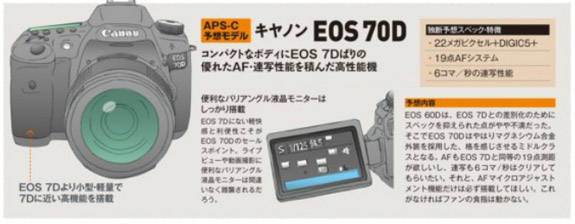
una rivista in Giappone chiamato CAPA potrebbe aver mostrato specifiche per 2 fotocamere Canon, la prima essendo la 70D e la successiva è il lungo parlato di EOS-3D. La rivista è abbastanza rispettato, e tutto questo potrebbe essere del tutto plausibile.
Con la nuova venuta Rebel 8 giugno 2012, e la prevedibile mirrorless a seguito poco dopo, Io sono sicuro se una di queste telecamere sono in programma per un annuncio in tempi brevi.

Canon 70D
  • 22MP e DIGIC5 +
  • 19 punti AF
  • 6 FPS
Canon EOS 3D
  • 30 + megapixel, 1D-class corpo
  • Doppio Digic5 + processori per 6 FPS
  • 61-sistema di punti AF, le funzioni principali come 1DX
  • Dotata di flash (o trasmettitore Speedlite) 

Sekonic L-308DC DigiCineMate Light Meter with Protective Skin

News image
Sekonic has announced that the L-308DC DigiCineMate is now available in the U.S. with a special Protective Orange Skin. Now available at time of purchase, the colourful, sure-grip orange skin makes the DigiCineMate easy to find in any gadget bag, comfortable to operate, and adds a degree of safety when placed on surface.
Sekonic Press Release
Sekonic Announces Availability of L-308DC DigiCineMate Light Meter with Protective Skin
Compact light meter simplifies light control for digital videographers shooting with DSLR cameras and now ships with a highly visible orange skin
North White Plains, NY (June 1, 2012) – Sekonic announces today that the L-308DC DigiCineMate – a simple and easy-to-use compact light meter that is ideal for today’s DSLR videographers and digital cinematographers as well as still photographers – is now available in the U.S. with a special Protective Orange Skin.
“Capturing motion is not the same as taking a still photograph,” said Phil Bradon, Sekonic’s USA Product Marketing Manager. “Today’s DSLR videographers cannot rely on in-camera metering to balance light levels. Videographers need to control lighting to assure scene-to-scene continuity. They need a light meter. The L-308DC DigiCineMate provides everything they need in a small, compact package with unrivaled ease of use.”
Now available at time of purchase, the colorful, sure-grip orange skin makes it easy to find in any gadget bag, comfortable to operate, and adds a degree of safety when placed on surface. This amazing, compact light meter features a full range of shutter speeds plus a special grouping of cine speeds and shutter angles and indicates exposure in f-stops to one-tenth step. The unit’s LCD readout can be customized to display only specific functions needed for the task at hand for fast, easy operation.
L-308DC DigiCineMate Features
Three Ways to Meter
The compact, Sekonic L-308DC is the first meter that can be customized to display only specific functions needed for the task at hand for fast, easy operation.
HD Cine Mode: Perfect for today’s DSLR videographers. Users can make exposure readings and control light using shutter speeds and frame rates and get aperture settings with one-tenth step accuracy.
Cine Mode: Designed for digital cinematography. Users can select from the most useful frame rates and shutter angles for exposure control with one-tenth stop accuracy. Lux and foot-candle readout enables quick set up of lights.
Photo Mode: Full control for traditional still-image photographers. Shutter-priority display of a full range of ambient and flash functions including Cord and Cordless flash measurement as well as ambient EV measurement.
Three Ways to Measure Light
The L-308DC’s Lumisphere provides incident light readings for nearly foolproof exposure readings and enables lighting that scene before the talent arrives.
The Lumidisc is perfect for lighting green screens, adjusting ratios and taking lux and foot-candle measurements.
Reflected light readings enable measuring the brightness of subject tones, gray cards, light sources or window light.
Calibration Compensation
Adjust the Sekonic L-308DC to film or digital camera sensors or match the L-308DC to other handheld meters.
Custom Setting
Three custom settings tune meter operations and displays to fit camera and metering requirements.
Illuminance Measurement
Lux (lx) and foot-candle (fc) display is especially useful for cinematography, theatrical and other applications that require precise control of light source brightness. Custom settings allow users to select lux, foot-candle or no display.
*Features and specification are subject to change without notice.
About Sekonic Corporation
Sekonic Corporation Japan provides the widest range of light measurement devices for photographers around the world. Established in June 1951 as Seiko Electric Industries Co., Ltd., the first Sekonic brand exposure meter introduced was the revolutionary Sekonic P-1.
Over the years, worldwide demand for exposure meters resulted in the growth and construction of a new factory in June of 1959. By August of 1961 the Tokyo facility was authorized as a JIS Designated Factory for “electric exposure meters for photographic use”.
Through the years Sekonic meters were so well recognized that in February 1984 the Sekonic Digipro X-1 and L-518 meters, were taken into space on the NASA Space Shuttle. Today Sekonic continues to produce and develop meters for every aspect of photography serving the film, video, cinematography and digital photographic marketplace.
Sekonic products are marketed exclusively by MAC Group (http://www.MACGroupUS.com) in the USA, and sold by distributors around the world.

Induro Announces New Dual Range Hi-Hat Tripod Set

News image
Induro has announced the July 2012 availability of its new Dual Range (DR) Hi-Hat Tripod Set. Shown for the first time at NAB 2012, the new Induro DR Hi-Hat Tripod Set, designed with both photographers and videographers in mind, is a unique support system that provides a range of capabilities that makes this tripod compatible with the requirements of still cameras as well as video platforms. Boasting a surprisingly high load capacity of 220lb, the new DR Hi-Hat Tripod Set consists of both a short Aluminium Alloy tripod with 100mm Bowl, and a 100mm Half Ball Adapter. The Induro DR Hi-Hat Tripod Set will be available for $279.
Induro Press Release
Induro® Announces New Dual Range Hi-Hat Tripod Set
Unique support system for both still cameras and video cameras that can securely hold up to a 220 lb. load scheduled to be in stores July 2012
North White Plains, NY – (June 1, 2012) – Induro (http://www.indurogear.com), makers of tripods, heads and accessories designed for demanding professional photographers and videographers, announces July 2012 availability of the new Dual Range (DR) Hi-Hat Tripod Set.
Shown for the first time at NAB 2012, the new Induro DR Hi-Hat Tripod Set, designed with both photographers and videographers in mind, is a unique support system that provides a range of capabilities that makes this tripod compatible with the requirements of still cameras as well as video platforms. Supporting an unprecedented 220 lb. load, the new DR Hi-Hat Tripod Set consists of both a short Aluminum Alloy tripod with 100mm Bowl, and a 100mm Half Ball Adapter.
“We are so excited to soon be bringing this amazing compact, flexible and extremely strong tripod set to market,” said Jan Lederman, President of Induro. “Sure to please the most demanding photographers and videographers, this new tripod set meets and exceeds the standards set by other Hi-Hat and Low-Hat solutions.”
Matching traditional Hi-Hat dimensions, the DR Hi-Hat Tripod Set goes far beyond in terms of operational scope and flexibility. Each leg features a two section extension and three steps of variable angle adjustment, making height adjustments and terrain adjustments a breeze. Specially reinforced pivoting ovoid feet provide a sure grip on virtually any surface, plus the capability to be screwed, spiked or otherwise firmly secured to establish a rock-solid connection to the ground or a board.
Bubble levels are incorporated both on the tripod spider and the top plate of the half ball adapter. And three evenly spaced points provide secure 3/8” and 1/4” threaded mounts for accessories.
The Induro DR Hi-Hat Tripod Set will be available in stores in early July 2012 for $279. For more information visit http://www.indurogear.com .

About Induro
Determined to provide professional photographers and videographers with everything they need, Induro’s U.S.-based design team creates a premium line of tripods, heads and photographic support gear that provide unequalled craftsman-like attention to detail and ease-of-use.
Induro manufactures and sells its distinctive product line to professional and aspiring professional photographers all over the world who want the finest support gear money can buy. High quality, superior engineering, unrivaled price and top performance form a strong foundation on which every Induro product is built.
The Induro product line is designed and built for today’s professional photographers and videographers whose needs are very different than of those from five or 10 years ago. The demands of today’s professionals are changing rapidly and the only way to keep ahead of these changes is to have a design team that understands their needs.
For more information visit http://www.indurogear.com . Induro products are designed and marketed exclusively by MAC Group (http://www.macgroupus.com) in the USA, and sold by distributors around the world.

Adobe Adds Lens Profile for Tamron SP 24-70mm f/2.8 Di VC USD

News image
Tamron has announced the addition of the Tamron SP 24-70mm F/2.8 Di VC USD for Canon mount to the lens profile for aberration correction offered for Adobe Photoshop CS6, ACR 7.1 and Lightoom 4.1. With the new profile, customers who own the lens will be able to utilize the above software for easy correction of lens distortion, chromatic aberrations and peripheral brightness based on design data.
Tamron Press Release
TAMRON ADDS THE SP 24-70MM F/2.8 DI VC USD (MODEL A007) FOR CANON MOUNT TO THE LINE-UP OF LENSES WITH LENS PROFILE FOR ABERRATION CORRECTION IN ADOBE® PHOTOSHOP® CS6, CAMERA RAW (A PHOTOSHOP® PLUG-IN), AND PHOTOSHOP LIGHTROOM® 4
June 4, 2012, Commack, New York - Tamron Co., Ltd announced the addition of the Tamron SP 24-70mm F/2.8 Di VC USD (Model A007) for Canon mount to the lens profile for aberration correction offered for Adobe® Photoshop® CS6, Photoshop’s raw image plug-in Camera Raw, and the photo management software Photoshop Lightroom® 4, all developed and offered by Adobe Systems Incorporated. The lens profile will be bundled with the Camera Raw 7.1 update and Photoshop Lightroom® 4.1. With the new profile, customers who own Tamron’s SP 24-70mm F/2.8 Di VC USD (Model A007E, Canon mount) will be able to utilize the above software for easy correction of lens distortion, chromatic aberrations and peripheral brightness based on design data.1
By installing the latest version of the Adobe DNG converter, customers who use Photoshop CS5/Lightroom 3 will be able to use the lens profile for the SP 24-70mm F/2.8 Di VC USD (Model A007E, Canon mount) as well as other Tamron lenses (listed below). Future lenses are expected to also be included in this profile.
1 The amount and quality of correction depends on the user.
Adobe and Photoshop are trademarks or registered trademarks of Adobe Systems Incorporated in the United States and other countries. 
DNG Converter download:
http://www.adobe.com/support/downloads/detail.jsp?ftpID=5389 (for Windows)
http://www.adobe.com/support/downloads/detail.jsp?ftpID=5388 (for Macintosh)
For further information, please refer to the Adobe website at http://kb2.adobe.com/cps/846/cpsid_84666.html
Di : For the digital SLR cameras with full-frame and APS-C format sensors.

venerdì 1 giugno 2012

Nikon UK Launches Cashback Promotion

News image
Nikon UK has launched a new promotion offering £50/€60 cashback on Nikon 1 J1 and V1 kits purchased before 31st August 2012. All claims must be received by the 30th September 2012 in order to qualify. For more information on the promotion, and how to submit your claim, visit the website below.
Website: Nikon UK
Nikon Press Release
NIKON LAUNCHES NEW CASHBACK – NIKON 1
London, UK, 31st May 2012: Nikon UK today launches a new Nikon 1 promotion offering £50/€60 cashback on Nikon 1 J1 and V1 kits purchased before 31st August 2012 (inclusive).
Customers purchasing any Nikon 1 J1 or V1 camera or lens combination are entitled to claim £50 /€60 cashback. The promotion runs from 31st May - 31st August 2012 (inclusive) and all claims must be received by the 30th September 2012 in order to qualify.
Simon Iddon, Product Manager for Nikon 1 says: “With summer holidays around the corner, now is the time to look at upgrading your camera. The Nikon 1 is ideal for families with young children – the superfast processor and Motion Snapshot feature mean you’ll be sure to capture those special moments as the camera starts recording before you’ve fully pressed the shutter button.”
The ultra-portable Nikon 1 interchangeable lens system camera has been designed to bring new levels of speed, simplicity and enjoyment to the way you capture your world. It offers all you need to shoot great photos and movies, with astonishingly fast autofocus system, strong low-light performance and clever shooting modes.
For more information on the promotion, and how to submit your claim, please visit: http://www.nikon.co.uk/cashback.
Terms and conditions apply. Offer is subject to availability.