giovedì 12 dicembre 2013

Sinar p-MF-L


News image

The Sinar p MF-L enables photographers to avail themselves of the unique quality characteristics of a Sinar view camera while using their Leica S high-end medium format camera body. In combination with the Sinar p system, Leica S owners gain access to perspective control, selective focus and the benefit of using high-resolution Sinaron lenses designed specifically for digital imaging. The Leica-specific mounting bracket ensures that the camera can be freely positioned along the optical axis. The Leica S functions are fully integrated into the Sinar CaptureFlow Leica software and therefore can be conveniently controlled from the computer.
Sinar Press Release
Sinar p-MF-L – The Leica S Integration
High-end Professional Photography for Leica S
The Sinar p MF-L was developed especially for photographers who wish to avail themselves of the unique quality characteristics of a Sinar view camera while using their Leica S high-end medium format camera body. Exact control of perspective and selective sharpness, the most important creative tools in photography, are set and evaluated precisely on a view camera – all these advantages are now available for Leica S users. In addition, this solution offers the benefit of a distinct increase in quality by using high-resolution Sinaron lenses designed specifically for digital imaging.
In combination with the Sinar p system the Leica S users gain access to professional high-end photography and the versatile assortment of professional accessories from the modular Sinar system. The format change from portrait to landscape can be easily performed without removing the camera. The Leica-specific mounting bracket ensures that the camera can be freely positioned along the optical axis. This function is an important contribution to exact picture framing or to reduce moirée.
The Leica S functions are fully integrated into the Sinar CaptureFlow Leica software and therefore can be conveniently controlled from the computer. In the live image, Sinar CaptureFlow features a sharpness indicator for fast and precise focusing.
About: Sinar Photography
Carrying forward in the 65-year Sinar tradition, Sinar Photography AG was founded in 2009. Their headquarters are located in Zurich, Switzerland, and their products include both analogue and digital camera systems used in high-end imaging. Their extensive product portfolio includes digital capture devices, digital lenses, software, cameras and accessories. Specialising in turnkey solutions designed as complete imaging systems; they are supplied and supported from a single source. This system approach makes ‘the Sinar difference’ and it’s this difference that delivers world-class imaging products with superb image-quality and excellent long-term reliability. Sinar cameras make the photographs you take!

Benro 3570F and 4570F Classic Tripods

News image

Kenro, the official UK and Ireland distributor of the Benro range of tripods has announced the availability of two larger sizes in its Classic Series. The two new versions - the 3570F and 4570F - are available in both aluminium and carbon-fibre versions; the latter having a maximum height of 1955mm.  The greater extended heights of the new tripods make photographing at full height considerably more comfortable for taller people and allow more flexibility and a wider choice of positioning to all users. Adjustable leg straps can be independently locked at 3 different angles for shooting in cramped conditions or on uneven surfaces, and ultra-low level shots are allowed by opening the tripod legs, making it possible to work at virtually ground level. The Benro Classic Tripod series has an SRP of £95.94 to £430.80 including VAT.
Kenro Press Release
New additions to the Benro Classic Tripod range

Kenro, the official UK and Ireland distributor of the acclaimed Benro range of tripods has announced the availability of two larger sizes in its Classic Series.

Manufactured from either high quality aluminium or 8 layer Carbon Fibre with magnesium alloy castings, the series of tripods have been designed squarely with the needs of the outdoor photographer in mind. They are the perfect solution for location, wildlife or landscape photographers who need a reliable tripod to take images in challenging conditions.

Fast to set up, tough and reliable, the Benro Classic Tripod Series ensures total flexibility and security. Adjustable leg straps can be independently locked at 3 different angles for shooting in cramped conditions or on uneven surfaces, and ultra-low level shots are allowed by opening the tripod legs, making it possible to work at virtually ground level.

A hook on the bottom of the reversible centre column enables the photographer to hang additional weights thus increasing stability. Another useful tool is the inbuilt spirit level and compass ensuring that the tripod is level whilst providing an accurate direction. Other features include head mounting screws, rapid action flip locks and padded grip on one leg lined with soft NBR.

The two new versions - the 3570F and 4570F - are available in both aluminium and carbon fibre; the latter having a maximum height of 1955mm.  The greater extended heights of the new tripods make photographing at full height considerably more comfortable for taller people and allow more flexibility and a wider choice of positioning to all users.

The Benro Classic Tripod series has an SRP of £95.94 to £430.80 including VAT. A durable carry case with straps is included with every tripod and all Benro tripods come with a 5-year warranty.

The Classic Series of tripods are supplied without heads. Choose from Benro's wide selection of Ball, Pan or Gimbal Heads to find the right solution for you.

Kenro Managing Director, Paul Kench commented: "The Classic Series of tripods are the perfect solution for outdoor photographers who regularly have to contend with tough environments. These new larger versions ensure that taller users can be more comfortable and other photographers can gain increased flexibility in their photography."

To view Kenro's full range, or for details of your nearest stockist please visit www.kenro.co.uk - alternatively call Kenro's head office on 01793 615836 or email sales@kenro.co.uk for further information.

Wacom Lowers Price for Cintiq 24HD touch

News image

Wacom has reduced the price of its Cintiq 24HD touch creative pen display. The flagship and largest member of the Cintiq product family is now available via the Wacom e-store and retail partners for £2,499.99 istead of  £2,999.99.
Wacom Press Release
Wacom lowers price for its Cintiq 24HD touch
10th December 2013 - Wacom, the worlds leading manufacturer of pen tablets and pen displays, today announces a price reduction for its Cintiq 24HD touch. The flagship and largest member of the Cintiq product family of creative pen displays is now available via the Wacom e-store and retail partners for only 2,499.99 GBP instead of 2,999.99 GBP. Both prices include VAT.

“With the Cintiq 24HD touch selling well and due to recent positive developments in our supply chain, we are able to pass the benefits to our customers”, said Rüdiger Spohrer, Vice President Marketing at Wacom Europe.

About the Cintiq 24HD touch
The Cintiq 24HD touch combines multi-touch with Wacom’s renowned pen technology whilst delivering a host of features to enhance workflow and user comfort. The 24-inch HD (1920 x 1200) widescreen displays 1.07 billion colours and 97 percent of Adobe’s colour gamut. Perfect for professionals with colour critical workflows, such as photographers, graphic designers, video and film editors as well as animators and game developers who will benefit from the life-like colour quality of the Cintiq 24HD touch. The ergonomically designed counter-weighted stand allows users to adjust the incline and height of the Cintiq for multiple working postures, even allowing the display to extend over the edge of the desk and float just above a user’s lap. Furthermore, the frame around the screen is designed to be a resting place for the hands and arms, providing easy access to the Touch Ring and shortcut and modifier ExpressKeys™ located on both sides of the Cintiq. The Cintiq 24HD touch incorporates Wacom’s most realistic pen experience, featuring 2048 levels of pressure sensitivity and 40 degrees of tilt control.

For more details on the Wacom Cintiq 24HD touch, follow the link: http://uk.shop.wacom.eu/products/cintiq/cintiq-24hd-touch/cintiq-24hd-touch/504?c=70177

Booq Python Slimpack Camera Bag

News image

Booq has revealed its latest product, the Python slimpack. Intelligently designed to pack all the necessary essentials photographer’s need to get the job done, the Python slimpack stores two DSLRs and up to four mid-size lenses, as well as one large zoom lens, tripod and a up to a 10-inch tablet. “The days where a camera was the only tool a photographer carried are long gone,” says booq’s Lead Designer, S. Kema Subsomboon. “Nowadays they carry a tablet with them, chargers, multiple lenses, their phone, and even more than one camera on occasion... The Python slimpack was designed with this in mind, keeping things divided with a multitude of pockets and padded walls, as well as dividers.” The Python slimpack is available today for $149.95 at the website below.
Website: booq
booq Press Release
Designed for the Modern Shutterbug, Introducing the booq Python slimpack Camera Bag
Compact backpack tailored to keep all your gear safely tucked away and within grasp for that spur of the moment shot
Sierra Madre, California – (December 5, 2013) – Booq, a leading brand of premium laptop bags, backpacks and iPad & iPhone carrying cases, introduces the Python slimpack. Intelligently designed to pack all the necessary essentials photographer’s need to get the job done, the Python slimpack stores two DSLRs and up to four mid-size lenses, as well as one large zoom lens, tripod and a up to a 10-inch tablet or iPad. Two ergonomically designed shoulder straps conform to all body types and maximize comfort when carrying a full load of gear. Removable padded dividers in the main camera compartment lets you arrange the interior to your liking in order to best fit lenses, chargers and cameras, while a top-access camera compartment keeps your gear nearby. The Python slimpack is available today for $149.95 at www.booqbags.com and retailers throughout the country.
Learn more about the Python slimpack here
Ingeniously crafted to meet the diverse demands of today’s digital age photographer while accommodating all their equipment, the Python slimpack is designed to fight against the outdoor elements creative professionals face daily. Water-repellent 1680 denier ballistic nylon exterior coupled with a removable rain poncho keeps your bag and gear safely protected and dry when shooting in unfavorable outdoor conditions. Densely padded plush red interior protects your black camera gear and makes it standout, so you can reach in and grab what you need at moment’s notice without sacrificing the perfect shot.
An ultra-tough rubberized bottom fortifies the bag, allowing it to securely stand on its own and easily-access the top compartment that doubles as a base to set down your camera while shooting. A variety of YKK zippered exterior pockets open up to reveal concealed slots and additional storage for other essentials, so you can make the most out of its minimalist design without having to leave gear at home.
“The days where a camera was the only tool a photographer carried are long gone,” says booq’s Lead Designer, S. Kema Subsomboon. “Nowadays they carry a tablet with them, chargers, multiple lenses, their phone, and even more than one camera on occasion. With a lot of stuff it can be difficult to find and accommodate things, not to mention keep equipment from getting damaged. The Python slimpack was designed with this in mind, keeping things divided with a multitude of pockets and padded walls, as well as dividers.”
All booq bags come tagged with a Terralinq serial number. Once registered, the booqTerralinq service may help reunite you with your lost & found bag.
The Python slimpack is shipping now and available for $149.95 at www.booqbags.com and various retailers throughout the U.S.

Canon EOS 7D Firmware 2.0.5 Available

Canon EOS 7D Firmware 2.0.5 Available
Firmware Version 2.0.5 incorporates the following fix:
  • Fixes a phenomenon in which the image files cannot be transferred using the FTP protocol via USB cable after the Canon EOS 7D camera has established a wireless connection to the Wireless File Transmitter WFT-E5A.
Firmware Version 2.0.5 is for cameras with firmware version 2.0.3. If the camera’s firmware is already Version 2.0.5, it is not necessary to update the firmware. Once the camera is updated to version 2.0.5, it cannot be restored to a previous firmware version.
Download Firmware Version 2.0.5 for the EOS 7D;
http://www.usa.canon.com/cusa/consumer/products/cameras/slr_cameras/eos_7d#DriversAndSoftware

venerdì 6 dicembre 2013

Tenba Reintroduces Three Classic Bags

News image
Tenba has reintroduced three vintage bag designs for a new generation of photographers. The Tenba Classic collection includes three models: the P211 courier bag, the P415 briefcase camera bag, and the Tenba 2 camera bag. These bags feature the same fine tailoring and uncompromising materials and hardware as when they were first launched up to thirty-four years ago. "These benchmark Tenba bag designs have been highly sought after for their legendary quality, great looks and high performance," said Peter Waisnor, Marketing Manager of Tenba. "After fielding thousands of requests for these bags from around the world, we decided it was time to bring them to a current generation of photographers." Tenba Classic bags began shipping on December 1st at a suggested retail price of $59.95 for the Tenba 2, $89.95 for the P211, and $169.95 for the P415.
Tenba Press Release
Tenba Introduces New Classic Bags

Vintage benchmark designs made available to a new generation of photographers

North White Plains, NY - December 3, 2013 - Leading the way in carrying solutions for over 30 years, Tenba announces a reintroduction of three vintage bag designs for a new generation of photographers. The Tenba Classic collection includes three models: the P211 courier bag, the P415 briefcase camera bag, and the Tenba 2 camera bag. These new Classic bags feature the same fine tailoring and uncompromising materials and hardware as when they were first launched up to thirty-four years ago.

The P211 originally introduced in 1979, was the first slim courier camera bag. It features Tenba's patented lower lens compartment, which allows extra lenses and other gear to be as quick to access as the gear in the main compartment. The P415 came to market in 1986, and was the first truly great camera briefcase. A side zipper allows the bag to instantly double in size to accommodate additional gear when necessary. The Tenba 2 was designed in 1979 as the original minimalist camera bag: just one main padded camera compartment, and two slim pockets front and back.

Each Tenba Classic bag is made with the same materials and hardware as when they were first introduced: high-density nylon exteriors, YKK zippers and clips, genuine leather handles and embossed leather logos.

"These benchmark Tenba bag designs have been highly sought after for their legendary quality, great looks and high performance," said Peter Waisnor, Marketing Manager of Tenba. "After fielding thousands of requests for these bags from around the world, we decided it was time to bring them to a current generation of photographers."

Tenba Classic bags began shipping on December 1st at a suggested retail price of $59.95 for the Tenba 2, $89.95 for the P211, and $169.95 for the P415. To find more information about the Tenba Classic bags, and to see a full video demonstration of all Tenba products, visit www.tenba.com .

About Tenba
Tenba provides innovative carrying case solutions for professional photographers and filmmakers, and their full equipment arsenal. Tenba introduced the world to soft-sided, professional camera bags in 1977, and has been an innovation and quality leader in the decades since. With so many years of experience in bag development and construction, along with a unique level of closeness and daily connection to the professional imaging community, Tenba is truly dialed-in to both the real-world needs of its customers and the latest in design trends, materials and manufacturing. With its own, U.S.-based, dedicated "bag lab" product development center and manufacturing facilities, both domestic and abroad, Tenba's resources and capabilities allow the company to create unique and exceptional carrying and transport solutions for serious imagemakers.

Tenba products are designed and marketed exclusively by MAC Group (MACgroupUS.com) in the USA, and are sold by distributors around the world.

PocketWizard Announces Instant Rebates

News image
The MAC Group has announced a Winter Holiday instant rebate of $25 for US customers that purchase one or more PocketWizard MiniTT1 and/or FlexTT5 radios. Likewise, purchasers of PocketWizard PlusX and/or Plus III radios are eligible for a $15 mail-in rebate for each radio they buy. The instant rebate is available only for new inventory purchased from authorized PocketWizard Dealers in the US. The promotion will run throughout this month.
Press Release
MAC Group USA Announces Instant Rebates On Selected PocketWizard® Radios

Instant rebates available in the U.S. for PocketWizard Plus®X, Plus®III, MiniTT1® and FlexTT5® Wireless Triggering Systems

North White Plains, NY - (December 3, 2013) - MAC Group, a leading manufacturer and distributor of professional photographic equipment, announces today a Winter Holiday instant rebate of $25 for U.S. customers that purchase one or more PocketWizard MiniTT1 and/or FlexTT5 radios for Canon or Nikon Digital Single-lens Reflex (DSLR) cameras. Likewise, purchasers of PocketWizard PlusX and/or Plus III radios are eligible for a $15 mail-in rebate for each radio they purchase.

The instant rebate is available only for new inventory purchased from authorized PocketWizard Dealers in the U.S. between December 1, 2013 through December 31, 2013 and will be awarded to eligible consumers at the time of purchase.

"PocketWizard radios offer photographers the most flexible and reliable solutions for remote camera and flash triggering for both studio and on-location shooting," said Phil Bradon, PocketWizard Marketing Manager for MAC Group USA, the U.S. distributor of PocketWizard wireless triggering systems. "Covering both the ControlTL and Standard radios, this instant rebate makes it easier for photographers new to wireless triggering and long-time PocketWizard photographers to experience the latest, and most advanced PocketWizard radios at a great price."

About PocketWizard
Incorporating the latest radio technology, PocketWizard radio triggers exceed the demands of the professional and serious amateur photographers with durability, ease of use, advanced capabilities and legendary reliability. PocketWizard products, including the PlusX, Plus III, Plus II, MultiMAX, MiniTT1 and FlexTT5 are made by LPA Design, based in South Burlington, Vermont and sold by distributors around the world including the MAC Group in the USA.

About MAC Group
MAC Group is a sales and marketing company dedicated to supplying photographers, videographers, educators and students with the world's finest image-making tools. In addition to the brands it represents in the USA, MAC Group designs and distributes Tenba and Induro products internationally.

iResizer 2.4

News image
TeoreX has updated iResizer, a simple yet capable utility designed to resize pictures and remove undesired objects. Version 2.4 adds a feature enabling users to automatically resize their photos for Instagram without cropping. You only need to mark areas on the photo you would like to preserve, and run Instagram resizing. iResizer is available for Windows and Mac OS, priced at $19.99.
Teorex Press Release
iResizer 2.4 Features Instant Resize of  Images for Instagram
TeoreX announces iResizer 2.4, a new version of the image resizing and anti-cropping tool. Implementing an intellectual approach to resizing, the program can remove unwanted objects from a picture or reduce spacing between objects by “folding” the photo using a special algorithm.
Often the only thing that spoils a perfect picture is its sizing. Wrong aspect ratio, too much empty space between objects, non-ideal cropping and so on. iResizer, a cross-platform tool fixes all such issues by applying smart algorithms that virtually “folds” a photo, just like a paper picture, so that unnecessary parts and fragments simply disappear.
With such powerful core inside, iResizer quickly and virtually with no efforts repairs such typical problems. Briefly, a user merely selects objects he wants to preserve their size and aspect, and specifies the desired picture format, size and aspect ratio. The program automatically does all the rest.
With the latest update 2.4, iResizer got even more cool automation. The focal point of the new version is autoresize of photos for Instagram without cropping. Instagram accepts square photos only, and trying to upload hundreds of 4:3 photos can be a pain. With iResizer, a user does the job in two steps: first, mark areas on the photo he wants to preserve, and run Instagram resizing!
Among other changes in the new release are 64-bit support, the new Lasso and Polygonal Lasso selection tools, the ability to subtract an area from selection and many small fixes and enhancements including saving the current image with default settings with a hotkey.
Overall, iResizer is an easy-to-use content aware image resizing tool with low requirements and high potential.
Pricing and availability
iResizer is a free-to-try application. The full version costs $19.99. The program is available for Windows XP or higher and for Max OS X 10.7 or higher.
Links
Website: http://www.iresizer.com/
Download link (PC): http://www.iresizer.com/iResizerSetup.exe
Download link (Mac): http://www.iresizer.com/iResizer.dmg
About
TeoreX is a small software development company founded in 2011 focusing on building simple yet extremely helpful graphics and multimedia tools. The product line includes Inpaint, Batch Inpaint, iResizer, PhotoStitcher, MultiView Inpaint and FolderIco.

Samyang 10mm f/2.8 ED AS NCS CS

News image
The Samyang 10mm f/2.8 ED AS NCS CS is a new manual-focus, rectilinear ultra-wide angle lens for cameras with APS-C and FourThirds sized sensors. With an optical formula comprising fourteen elements in ten groups, the Samyang 10mm f/2.8 ED AS NCS CS offers an angle of view of 109.5° on Fuji, Nikon, Pentax, Samsung and Sony bodies, 105.9° on Canon DSLRS and CSCs, and 93.4° on (Micro) Four Thirds models. Other key features include a nano-crystal anti-reflex coating, a manual aperture ring, an integrated hood, one extra-low dispersion and two aspeherical lens elements, a close-focus point of 25cm and a six-bladed iris diaphragm. The lens will be available from the end of January 2014. The suggested retail price for the Nikon version, which has a CPU to enable open-aperture metering and the use of various non-manual exposure modes, is £469.99. All other fittings carry a suggested retail price of £429.99.
Samyang Press Release
Samyang 10mm 1:2.8 ED AS NCS CS
December 6th 2013 - Samyang release new wide-angle 10mm 1:2.8 ED AS NCS CS lens in APS-C format.
Samyang has introduced a focused development program to obtain the highest possible optical parameters and reduce the product's size at the same time. These efforts resulted in the latest version of Samyang 10 1:2.8 ED AS NCS CS lens featuring parameters and capabilities comparable to the best wide-angle prime and zoom lenses on the market.
The new Samyang 10mm 1:2.8 ED AS NCS CS is an ideal tool for indoor, architecture and landscape photography. It provides an exceptionally wide field of view of up to 109.5 degrees and rectilinear image mapping function. Owing to a fast f/2.8 lens speed you can also use the lens in low light conditions as well as sports photography and photojournalism purposes. The product's optics comprises 14 elements divided into 10 groups, this includes 2 aspherical AS lenses and one lens made of extra-low dispersion glass. During development works on the prototype version the lens was fitted with an embedded lens hood which ensures a more compact size and reduces its weight by approximately 160 grams*.
* - applicable to a version with Canon E mount
NCS - Nano Coating System
The Samyang 10mm 1:2.8 ED AS NCS CS is the first Samyang Optics lens to feature a nano crystal anti-reflection coating system. This technology provides a lower reflection factor than (U)MC system as the coating is now applied more evenly on the surface of the lens. Benefits brought by the nano crystal layer include better light transmission, increased resistance to reflections and higher contrast, and all of this translates into supreme optical resolution of the lens.
The lens will be available from the end of January 2014.
The suggested retail price for the Nikon version is £469.99 inc VAT
All other fittings carry a suggested retail price of £429.99 inc VAT

martedì 3 dicembre 2013

Win Nero 2014 Platinum!

News image
We've teamed up with Nero to give away a copy of Nero 2014 Platinum!
Nero 2014 Platinum enables users to connect, access and use all their media at home and on the go. It is ideal for people who want to centralise all their content in one place and make it accessible from any device, allowing users to manage, create, convert, play, and share movies, music and photos across all their devices.
Nero 2014 Platinum allows users to achieve professional results quickly and easily with fully integrated applications. Users will enjoy Nero 2014’s fast and easy ripping, conversion, and video editing with Ultra HD (4K) support. The new version also includes full media management functions, superior disc and file playback including Blu-ray 3D discs, Nero Play to TV streaming and the best burning tools in the industry.
Terms and Conditions
1. This competition closes on 31st December 2013.
2. By entering this competition you will also be opting-in to Photography Blog’s monthly e-newsletter, but you have the option to unsubscribe at any time.
3. Only one entry per person only.
4. No entries accepted from employees of Photography Blog or Nero.
5. The winner will be announced on the Photography Blog website following the closing date and contacted via email only, so a valid email address required.
6. The featured prize is a copy of Nero 2014 Platinum.

domenica 1 dicembre 2013

Sekonic L-478DR/D Bundle

News image

For a limited time, JP Distribution will be offering the Sekonic L-478DR and L-478D light meters in a bundle with a five-degree spot finder and new meter/spot finder case. All three items are offered at a discount of 15% off the regular individual pricing SRP.

Perfect Photo Suite 8 Now Available

News image

onOne Software has now released Perfect Photo Suite 8, which had been announced back in September. Key new features include the Perfect Enhance module for essential photo adjustments, the Perfect Eraser with content-aware fill technology, the Perfect Batch processing utility for applying workflows to multiple images at once, and a re-engineered Perfect Effects module with twice as many filters, customisable presets, and integrated FocalPoint technology. The new Perfect Photo Suite 8 will be available 26th November in three editions: Premium, Standard, and an edition for Adobe Lightroom & Apple Aperture. Perfect Photo Suite 8 for Adobe Lightroom & Apple Aperture works with Lightroom, Aperture, Photoshop Elements, and as a standalone application. It is available for $129.95; upgrades are $79.95. The Standard Edition works as a complete standalone photo editor and is available for $79.95.
Onone Press Release
onOne Software Announces Availability of Perfect Photo Suite 8

New Perfect Eraser for Content-Aware Fill, Enhance and Browse Modules, Perfect Batch Processor, and Re-imagined Effects Module Evolve Popular Plug-In Into a Complete Photo Editing Solution for Every Workflow
onOne Software, Inc®., a leading developer of innovative digital photography solutions, today announced the availability of Perfect Photo Suite 8—the Photographer’s Choice for Photo Editing. Perfect Photo Suite 8 is a full-featured, standalone photo editor that also integrates seamlessly with Adobe® Photoshop®, Lightroom®, Photoshop Elements, and Apple® Aperture. It includes all the best tools a photographer needs to create stunning images.
Key new features include the Perfect Eraser, with content-aware fill technology; the Perfect Enhance module for essential photo adjustments; a new Browser that streamlines direct access to images wherever they are located; the Perfect Batch engine that applies presets to multiple images with a single click; and a re-engineered Perfect Effects module, with twice as many adjustable filters, customizable presets, and integrated FocalPoint™ technology. These new tools and capabilities alongside Perfect Photo Suite 8’s eight modules, one-click presets, tools for automated enhancements, and powerful controls allow photographers to enhance, retouch, and stylize images in a layered workflow, replace backgrounds, create high-quality enlargements, and prepare images for output—giving them the ability to express their creativity and transform their photos quickly and easily.
“We are extremely excited about Perfect Photo Suite 8,” said Craig Keudell, president of onOne Software. “This version is the result of what photographers have been asking for, not only from us but from the industry as a whole. We’re grateful for the contributions and feedback the photography community has invested in our effort and we believe that we’ve created an extraordinarily powerful image editing tool that meets their specific needs in return.”
After a successful public beta program for Perfect Photo Suite 8, many photographers had a chance to try out the new version and give their feedback. “The attention to your user’s needs is unmatched,” said Rebecca Lyyski, owner of Lyyski’s Designs. “As a graphic designer and photographer with an elevated workload, your product has made editing my professional photography a pleasure instead of a chore,” she adds. Greg Lambert, public beta user and onOne Software photo contest winner shared, “Perfect Photo Suite 8 continues to evolve by refining its existing capability, streamlining the interface and providing some new and exciting tools and presets to enable photographers to produce the images they visualize when they press the shutter button.”
The New Perfect Photo Suite 8 Features:
  • Eight integrated modules: Effects, Enhance, B&W, Portrait, Mask, Layers, Resize, and Browse. Each module is designed to target a specific image-processing task. Together, they help photographers enhance, retouch, and stylize images in a layered workflow, replace backgrounds, create high-quality enlargements, and prepare images for use in various capacities.
  • New Module! Perfect Enhance provides essential tools for basic enhancements, such as brightness and contrast adjustments; colorcast, dust spot, and power line removal; and the addition of vignettes. It is an ideal module to start with when using Perfect Photo Suite 8 as a standalone application or when quick corrections are needed.
  • New Module! Browse provides convenient and direct access to image files wherever they are stored—whether they are on a computer, an external drive, a connected network, or on a cloud-based storage service like Dropbox, Google Drive, or Apple’s Photo Stream.
  • Reimagined! Perfect Effects: As a cornerstone of Perfect Photo Suite 8, the Effects module has been redesigned by adding adjustable filters and customizable presets, making it the most powerful and versatile image stylization tool available on the market today.
  • Twice as Many Adjustable Filters to create the most sought-after looks, including:
  • Dynamic Contrast: Adds stunning clarity to images and makes them pop by exaggerating the levels of contrast, without sacrificing highlight and shadow detail, creating halos, or affecting saturation.
  • Lens Blur: Includes the best parts of FocalPoint technology to create bokeh, tilt-shift, and selective focus effects after the shot.
  • HDR: Gives images the edgy look of high dynamic range. Settings are adjustable and create effects that range from subtle to surreal.
  • Vintage: Turns photos into a nostalgic memory with retro-style filters.
  • Powerful Brushes provide the right results for specific editing tasks:
  • Perfect Eraser removes objects with content-aware fill technology
  • Retouch Brush uses spot healing to remove small distractions
  • Clone Brush removes unwanted items by replicating and covering specified areas of an image
  • Masking Brush reveals underlying layers or selectively applies effects
  • Perfect Brush delivers precise edge-detection masking
  • Hundreds of Customizable Presets are available throughout Perfect Photo Suite 8 that make it easy for any photographer to instantly create an image they love. Presets can also be used as starting points for creativity and efficiency. Presets are included in the Enhance, Effects, B&W, Portrait, and Resize modules.
  • Improved Masking Bug in the Effects and Layers modules make mask creation easier and more intuitive.
  • Perfect Batch engine simultaneously applies presets from multiple modules and a watermark to a selected group of images.
Availability and Pricing
The new Perfect Photo Suite 8 is now available at http://www.ononesoftware.com/store. Perfect Photo Suite 8 is available in three editions: Premium, Standard, and for Adobe Lightroom & Apple Aperture.
The Premium Edition works with Adobe Photoshop, Lightroom, Photoshop Elements, Apple Aperture, and as a standalone application. It is priced at $179.95. Owners of previous versions of Perfect Photo Suite Premium Edition can upgrade for $99.95. For a limited time, orders of Perfect Photo Suite 8 Premium Edition will include a special collection of Professional Presets and The Essential Video Guide to Perfect Photo Suite 8, which provides a comprehensive collection of getting started training videos for Perfect Photo Suite 8—for free ($80 value). This offer ends on December 3, 2013.
Perfect Photo Suite 8 for Adobe Lightroom & Apple Aperture works with Lightroom, Aperture, Photoshop Elements, and as a standalone application. It is available for $129.95; upgrades are $79.95. The Standard Edition works as a complete standalone photo editor and is available for $79.95. For more information on Perfect Photo Suite 8, please visit http://www.ononesoftware.com. A 30-day Money Back Guarantee backs all onOne Software products.
About onOne Software
onOne Software, Inc., a leading developer of innovative software tools for photographers, develops timesaving software solutions for professional and advanced amateur photographers. onOne Software solutions have been created to help photographers spend more of their time behind the camera taking pictures instead of the computer workstation. Such solutions include a wide range of easy-to-use standalone applications and plug-in enhancements for Adobe Photoshop, Photoshop Elements, Photoshop Lightroom, Apple Aperture, and iPhone and iPad applications. Founded in 2005, onOne Software is a privately held company located in Portland, Oregon. For additional information, visit http://www.ononesoftware.com or call 1-888-968-1468.

Olympus Releases Three Firmware Updates

News image

Olympus has announced firmware updates for the OM-D E-M1 compact system camera (read review), the M.Zuiko Digital ED 12-50mm f/3.5-6.3 EZ lens (read review) and the Stylus XZ-2 premium compact camera (read review). Firmware version 1.1 for the Olympus OM-D E-M1 improves Live Bulb image quality while noise reduction is on, enhances AF operation including C-AF, improves image stabilisation in the Sports and Children scene modes, and corrects chromatic aberration caused by the Panasonic Lumix G Vario 14-140mm f/3.5-5.6 lens. Firmware update 1.3 for the Olympus Stylus XZ-2 improves AF performance when you use a single target in a low-light situation. Finally, the firmware upgrade for the 12-50mm lens improves stability when using electronic zoom in combination with Panasonic cameras. As usual those updating their firmware should use the company's free Digital Camera Updater utility.

Free Datacolor Webinars

News image

Datacolor will be hosting two new free-to-attend webinars in December. On Thursday, 5th December, Datacolor expert David Saffir and Google Nik Photography expert Dan Hughes will be hosting an online seminar titled, "Taking Control of Landscape Photography with Datacolor and the Nik Collection." Starting at 7p.m., this webinar will cover best practices in colour management throughout the workflow, capturing landscape scenes and post-processing in the digital darkroom using Nik Software products Viveza 2, ColorEfexPro 4 and SharpenerPro 3.0. The second session, "Highlights of the 2013 Creative Roadshows" (Tuesday, 10th December, 7p.m.) hosted by Datacolor expert Richard West, will provide tips and tricks on how to build and optimise your imaging workflow whilst maintaining colour accuracy throughout. To register, visit the website below.
Website: DataColor Webinars
Datacolor Press Release
Datacolor announces a new series of free colour management webinars
New online seminars hosted in December by the expert in colour management for amateur and professional photographers, as well as graphic designers
Dietlikon/Zürich – 27th November 2013 – Datacolor, a global leader in colour management solutions will be hosting new free-to-attend webinars in December. All online seminars arepresented by Datacolor experts, and address various themes around colour management. On December’s agenda: Taking Control of Landscape Photography with Datacolor and the Nik Collection, with Dan Hughes and David Saffir; Highlights of the 2013 Creative Roadshows with Richard West.
All webinars are free, and anyone can register on www.datacolor.com/webinars.
Thursday, 5th December, 7 PM:
Taking Control of Landscape Photography with Datacolor and the Nik Collection – with Dan Hughes and David Saffir
In this webinar, Datacolor expert David Saffir and Google Nik Photography expert Dan Hughes will show their tips and techniques, from establishing best practices in colour management throughout the workflow, to capturing landscape scenes, continuing in post-processing in the digital darkroom using Nik Software products Viveza 2, ColorEfexPro 4 and SharpenerPro 3.0.
This session is designed for amateurs, as well as semi-pros and pros and will last an hour.
Tuesday, 10th December, 7 PM:
Highlights of the 2013 Creative Roadshows – with Richard West
In this webinar, Datacolor expert Richard West will cover off the highlights of the year's launches in the Photographic and Creative world. In particular, he will give tips and tricks on how to build and optimise your imaging workflow whilst maintaining colour accuracy throughout. The Webinar will include advice on how to work to get the best out of various partner software and hardware solutions including Adobe Photoshop Lightroom, Epson printers and various other manufacturers.
The webinar will also feature a guest presentation from onOne with demonstrations of their new Perfect Photo Suite 8.
This webinar will include Festive Goodies. .
This session is designed for amateurs, as well as semi-pros and pros and will last an hour.
For more information about Datacolor and its products and services, visit www.datacolor.com

domenica 17 novembre 2013

Kenro Launches New Range of Benro Messenger Bags

News image

Kenro, the UK and Ireland Distributor of Benro products has launched a new range of Cool Walker Messenger Bags. The bags open quickly allowing rapid access to photo gear and small pockets at the front of the bag are great for the easy retrieval of mobile phones, wallets and other small accessories. The front and back pockets are large enough to store books, papers or magazines and the centre storage compartment is removable, allowing the bag to be used as a regular shoulder bag if required. This series comes in two variations, the M100N with a price of £82.20 and the M200N costing £88.68.
Kenro Press Release
Kenro launches new range of Benro Messenger Bags

Kenro, the UK and Ireland Distributor of Benro products has announced the availability of Cool Walker Messenger Bags, specifically designed for photographers who want fast access to equipment.

The bags open quickly allowing rapid access to photo gear and small pockets at the front of the bag are great for the easy retrieval of mobile phones, wallets and other small accessories. The front and back pockets are large enough to store books, papers or magazines and the centre storage compartment is removable, allowing the bag to be used as a regular shoulder bag if required.

Helping to achieve its high level of comfort is an ergonomic shoulder strap and padded handle. Another great feature is the mesh on the front and rear which allows the highest level of ventilation and provides the option of attaching the bag to a trolley case when transporting.

The bottom of the bag is reinforced with durable shock proof and abrasion resistant material, which allows easy cleaning and lengthens the life of the bag, which is manufactured from 1200D Nylon water repellent material. Inside the bag there's also a bungee cord to help keep it free from dust and droplets of water.

Kenro Managing Director, Paul Kench commented on the release: "The Cool Walker Messenger Bag is an essential, stylish and comfortable camera bag with a large amount of storage space and huge versatility."

This series comes in two variations, the M100N with a price of £82.20 (SRP) and the M200N costing £88.68 (SRP).

To view Kenro's full range, or for details of your nearest stockist please visit www.kenro.co.uk - alternatively call Kenro's head office on 01793 615836 for further information.

Magmod Flash Modifiers


Tucson, Arizona based photographer Spencer Boerup has launched a Kickstarter campaign to help fund a new, magnetic system of mounting flash modifiers that works with almost any strobe. "For photographers, attaching a flash modifier is a chore," Boerup says. "Either you need a special mount designed just your flash, or you have to use velcro, elastic, or a whole slew of other materials just to get your modifiers to stay in place." Magmod promises to change it all. Each Magmod modifier attaches to your speedlight by magnetising to the MagGrip, an elastic,one-size-fits-all band that stretches around the flash head. The system is modular - in addition to the MagGrip, it currently includes the MagGrid honeycomb grid and the MagGel Kit, which comprises a gel slot and various colour temperature modifying gels. You can add as many modifiers as you want, simply stacking one on top of the other. Interested readers are encouraged to visit the project's Kickstarter page.

Triggertrap Redsnap

News image

Triggertrap's Redsnap accessory, a modular camera trigger for high-speed, camera-trap and time-lapse photography, has exceeded its funding goal of $50,000 on Kickstarter by nearly 6 times. Billed as "one of the fastest, easiest to use, and most affordable high-speed flash- and camera triggers money can't yet buy," Triggertrap Redsnap uses interchangeable sensor modules that you can snap on when you need them, and tuck away in your camera bag when you don't. It has three outputs, so you can hook up three cameras, three flashes, or a combination of both. It also has a special connector allowing it to talk to the Triggertrap Mobile App for iOS and Android. With over £288,000 pledged, Triggertrap Redsnap has exceeded all of its stretch goals, and will go into production in the first half of 2014.
Triggertrap Press Release
Triggertrap Returns to Kickstarter with Redsnap
An infinitely expandable high-speed camera triggering tool, Triggertrap Redsnap will put an endlessly creative set of sensor triggering capabilities at the fingertips of photographers of any skill level
LONDON – Triggertrap, developer of creatively-thrilling camera triggering solutions which eliminate the barriers to exciting photographic techniques, today announced its latest Kickstarter campaign to support the next generation of camera triggering technology from the boffins at the Triggertrap skunk works. Its latest invention is the Triggertrap Redsnap (short URL:tri.gg/kick), an infinitely expandable modular triggering system that puts high-speed lasers, motion sensors and sound triggers in the camera bag of every photographer at a fraction of the price of currently available accessories.
The Kickstarter campaign will bring Redsnap into the hands of professional and enthusiast photographers everywhere. Campaign backers will be rewarded not only with bragging rights as early adopters, but with cool wallet-jamming savings with backer packages being offered at about half of the anticipated retail price! With an array of funding options, backers will find several prepackaged kits available for their individual photographic needs ranging from the Timelapse Kit (£35) to a Wildlife Kit (£120) and multiple all-inclusive kits (£125-£190). For those backers that simply can’t wait to get their hands on Redsnap, top backers will earn special Queue Jumper status (£1,000), and be eligible for one of the extremely limited pre-production prototypes.
With each of its successive projects Triggertrap has continued to break down the traditional barriers to entry of creative photography techniques. The very company itself was brought to life compliments of the Kickstarter faithful back in 2011 with the launch of the Triggertrap v1. More recently, the company developed Triggertrap Mobile, which became tremendously popular. With Redsnap, Triggertrap is continuing to democratize once-complex, virtually unreachable photography techniques.
“We were extremely fortunate to have the community’s support for our first Kickstarter campaigns, and the support of our backers has not only provided the initial funding for multiple Triggertrap projects, but has been a point of inspiration that keeps us reaching for the next innovation,” said CEO and Triggertrap inventor Haje Jan Kamps. “If you thought Triggertrap v1 and Triggertrap Mobile opened your eyes to new techniques, Redsnap will leave you dizzy with creative options.”
Redsnap for High-Speed Flights of Fancy
Want to capture darts popping balloons, or the aggression-relief of smashing glass bottles with a hammer? These are techniques that traditionally would require numerous expensive tools; with Triggertrap Redsnap this is just the beginning of the brave new photographic world that will avail itself. How about speeding bullets, elusive night-stalking wildlife, or month-long timelapses? Now we’re talking!
The sensor modules are interchangeable, configurations are endlessly expandable, so they can be snapped on when you need them, tucked away when you don’t, or daisy-chained together for the unique triggering demands of just about any shoot.
Redsnap features three outputs, to hook up three cameras, three flashes or a combination of both. It also has a special connector allowing it to talk to our best-selling Triggertrap Mobile iOS and Android app, which features 14 additional triggering functions.
Geek Out with Some Redsnap Functionality
As a modular system, each kit builds off Redsnap, which on its own is a powerful camera triggering tool, and then snaps on additional blocks for laser sensors, infrared motion sensors and much more. The ability to make completely customizable combinations makes Redsnap one of the fastest, easiest to use and most affordable high-speed flash and camera triggers that money can’t buy…at least not yet!
Features of the Redsnap base block include:
·         A barrel of Timelapses: Running on a single set of AA batteries, month-long timelapses are a reality that can go on and on and on…
·         TimeWarp: As seen on Triggertrap Mobile, Redsnap features the world-exclusive TimeWarp mode, which enables photographers to take timelapses with acceleration
·         Long Exposure HDR: Redsnap makes Long Exposure HDR photography easy: Choose intervals from 1/3 to 2 EV steps, and up to 19 bracketed exposures per HDR set. Why would you need 19 exposures? Absolutely no idea, but it’s there if you want it.
·         Star Trail mode: Take a series of long exposure shots to get low-noise star trail photos, or hedge your bets to ensure you capture rare natural phenomena like meteors or slightly less natural, and slightly less rare phenomena like fireworks!
Triggertrap is continuing to develop new sensor blocks, but at launch, the initial lineup includes:
·         High Speed Laser Sensor: With a reaction time of less than 60 microseconds, a typical bullet only has the time to fly 24 millimeters before your flash captures the bullet in flight – think about that!
·         High Speed Sound Sensor: The sound sensor allows you to capture popping balloons, things smashing, and all manner of other cool destructive projects. Let your imagination be the limit!
·         High Speed Light Sensor: Forget missing the photo of the great lightning strike, the high speed light sensor stays on the lookout for you.
·         Passive Infrared Sensor: Think ‘burglar alarm’; the Passive Infrared (PIR) sensor doesn’t use a beam (hence the ‘passive’ thing), so it’s completely invisible - perfect for capturing sneaky photos whenever the sensor detects movement. Set it up out in nature to capture tigers, and lions, and bears (oh my!), but don’t let ‘wildlife’ limit your imagination. The PIR sensor can be used to shoot everything that moves: doors opening, cars driving by, and even kittens chasing butterflies (awwwww).
Don’t take our word for it. Check out the video and Kickstarter page to see just what Redsnap is capable of here, or jump over to the Triggertrap home page for some added detail atwww.triggertrap.com.
As a product still under development, Triggertrap Redsnap is subject to revisions before final availability.
About Triggertrap
Triggertrap Ltd was founded in 2011, and was brought to life through crowd-funding site Kickstarter. Based in the UK, the company’s flagship smartphone-based camera triggering solution, Triggertrap Mobile, has been downloaded more than half a million times and their triggers are in use by thousands of photographers in more than a hundred different countries. For more information, please visit www.triggertrap.com.

venerdì 15 novembre 2013

Review – Canon EF 200-400 f/4L IS 1.4x

Review – Canon EF 200-400 f/4L IS 1.4x
By: Justin VanLeeuwen | Twitter
Discuss the Canon EF 200-400 f/4L IS 1.4x

Many of my reviews are comparisons between lenses that have been upgraded and improved in Canon’s lineup.  With a hundred years of lens technology, there’s not always too much to change, or even new ways of doing the same thing: focal lengths, apertures, primes, zooms… everything’s been done!  Of course, this isn’t true: Canon blew us away with the 17mm f/4 L Tilt-Shift a few years ago, as well as the 8-15mm f/3.5 L Fisheye zoom which was unheard of.  Their latest ground-breaking release is the Canon 200-400 f/4 L IS USM Extender 1.4x.  That’s a mouthful. What does it all mean? It’s a zoom lens covering the focal range of 200 to 400mm, with a constant f/4 aperture and a built-in 1.4x extender which, when engaged, will change your zoom focal distance to 280mm-560mm and a constant f/5.6 aperture. It’s also likely that at a current retail price of about $12,000 (that’s twelve-thousand) you already know all this because, let’s face it, you’re not buying this lens unless you absolutely need it for your work or you’re wealthy and buy everything anyway.
Canon EF 200-400 f/4L IS 1.4x
Build
There’s little to discuss when it comes to the excellent build on this lens. Befitting of Canon’s white-lens lineup, it’s rock-solid (and rock-heavy). Over a full foot long (almost twenty inches with the hood attached), there is nothing subtle about it. The lens is fully weather-sealed; I can attest to this as I had it out in a freak downpour. It, and my 5DMKIII, came out none the worse.
The focus and zoom rings are very wide, comfortable, and turned with the perfect amount of tension. I had a brand new copy and I assume, as with any lens, they will get a bit looser with use.
The Canon 200-400 f/4 L IS USM Extender 1.4x has all the features we are used to on Canon’s super-telephoto lineup. As expected, all the switches are well placed, firm, and were not operated accidentally in use. The Focus preset button runs from the full range, 2m-6m and 6m to infinity. Canon’s AF/MF/PF is here as well. If you’re new to “PF”, here’s what Canon has to say about it:
“Helping moviemakers achieve smoother and more appealing focus shifts when filming on EOS DSLR cameras, Canon has included a new Power Focus (PF) mode on the company’s two new super telephoto lenses. This mode allows manual rack focusing to be operated smoothly by turning a playback ring that is normally used for the focus preset function. Both low and high speed focus shifting is available” [Canon USA].”
Toosje
5DMKIII,1/40th, f/5.6, ISO 3200, 200mm
A bit on Image Stabilization
“Optical Image Stabilizer technology makes hand-held photography more practical at slow shutter speeds*” (*Canon USA). IS helps free the camera and photographer from the tripod and gives you a bit more latitude to how and where you shoot. As a guide, it’s suggested that photographers’ shutter speeds should match the apparent focal length of the lens. So ideal shutter speeds on a full frame camera like the 1DX, 5DMKIII, or 6D would be about 1/400th of a second at 400mm. Of course, this has no bearing on stopping motion or action (though in many cases this will suffice). On a crop body like the Rebel series, 70D, or 7D you’d be looking to multiply that by the crop factor of the camera (1.6x) so 400mm would be 1/640th of a second, this makes sense as the apparent focal length is magnified, so are any potential shakes. The IS advantage, then, is to allow yourself a bit more working room to achieve sharp images. The stabilization compensates for movement and shake, effectively correcting the slight changes the photographer introduces into the image through movement. 4 stops brings the 1/400th rating down to 1/25th of a second, though excellent technique is still recommended and, again, this won’t stop your subject from moving. Obvious advantages to this are for people working indoors, where lighting is limited and you don’t need sports-level action stopping shutter speeds. Personally, I was able to get some decent shots handheld at 1/60th with the 200-400, but I truly recommend you use this with a monopod or a sturdy tripod with a proper gimbal head whenever possible.
The mode switch allows for three types of stabilization:
Mode 1 is for “regular” use which corrects for vibrations in all direction
Mode 2 compensates for moving subjects or panning where there is a bit of fluidity and motion already being introduced to the lens to capture an image.
Mode 3 “Corrects vibration only during exposure. During panning shots, corrects vibration during exposure only in one direction the same as MODE 2*.” [Canon USA].
There’s a focus preset button so you can set a specific focusing distance and return to it at any time by rotating the “Playback Ring” (a grooved metal ring between the focus ring and the front rubber grip). The front rubber grip also has four equally placed AF stop buttons which temporarily pause autofocus.g
Extender
What is unique to this lens is the built-in 1.4x Extender which allows the user to immediately extend the focal range for added compression and reach without having to remove the lens and fumble with an accessory. This is especially important in fast moving situations where taking the lens off the camera may result in a missed shot or even in harsh climate conditions where separating the body from the lens could result in breaking the weather seal and damaging  your system. The bulge at the side of the lens houses the optics for the extender and there’s a very secure and large switch that can be locked & unlocked in order to “plunk” the extender into place. The added glass of the extender will lose you a stop on your aperture, from f/4 to f/5.6.
Over the Love
Over the Love – EF 200-400 f/4L IS 1.4x
Focus
Some people may swoon over ultra-shallow depth of field lenses and yes, I do love me some wide-open f/2.8 bokeh. But at 400mm, f/4 isn’t so bad either, maintaining a decent level of detail on a subject while blurring out (and compressing) the background and creating lovely bokeh.
Focusing was quick and accurate, though maybe not as fast as something like Canon’s 70-200 f/2.8 L IS II. But considering the amount of glass that has to be moved, it was still impressive. Between AI Servo and AI Focus, I rarely missed a shot. The ability to track and zoom at such telephoto lengths was also very useful.
Because the aperture increases from f/4 to f/5.6, some Camera’s will lose their ability to focus completely, but the centre focus point. If you add another 1.4 extender (which you can, and I did), you will lose AF on all but the latest Canon bodies, and it will be centre point only since your aperture will now be f/8. Check the compatibility chart over on Canon’s website to see if your camera and lens combo is compatible: http://gdlp01.c-wss.com/gds/2/0300011592/01/ef200-400f4lis-e14-im-eng.pdf
Image
For this kind of money, you’d expect good… nay, great image quality.  As I mentioned, it’s not quite as crisp as any of the primes, nor, without any testing, did it seem as sharp. That isn’t to say it’s not better than 90% of the glass out there, and any softness I experienced while using it was completely my own fault. But just looking between files I shot with the Canon 300mm f/2.8 L IS II and this one, I have the feeling of a difference. Also note: adding extenders (even the internal one) will further reduce image quality. The built-in extender is optically matched to this lens and the results are still fantastic.
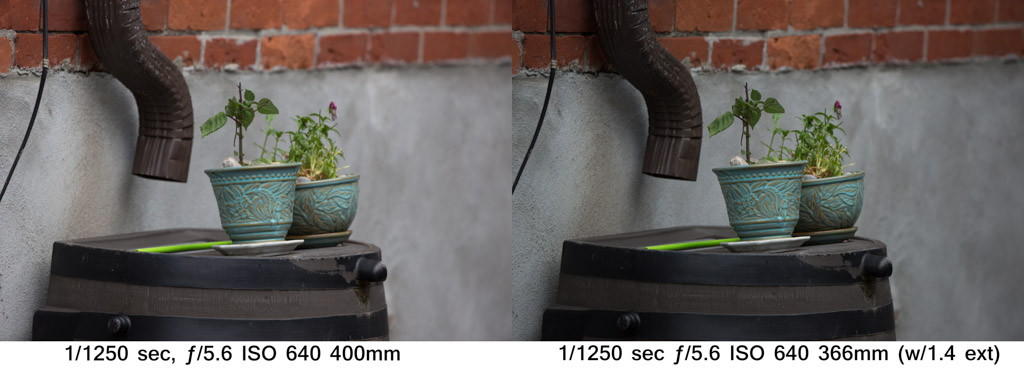
I did notice that, when switching on the extender, from f/4 to f/5.6 – and even correcting for the stop of light by lowering my shutter speed or increasing my ISO sensitivity, there was a loss of light either through vignetting or T-Stops that appeared to be almost a full stop. Here are some images illustrating this:
Light Loss
Light Loss
It is a minor inconvenience which can easily be compensated for. It’s also great that today’s cameras have such great low-light performance in order for us to achieve fast shutter speeds, at high ISO’s with still very clean results.
I also found there to be very little chromatic aberration, though it was present and was exaggerated when the extender was engaged. However it was nowhere near enough for me to notice at anything other than at a pixel-peeping level. Truly, the 200-400 will get its users the images they paid for.
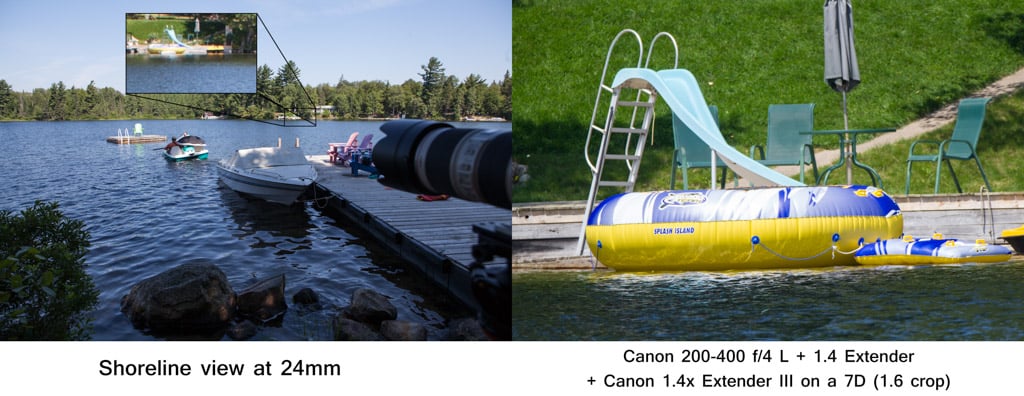
Just for fun, I wanted to see what the range was like shooting on an APS-C sensor camera (1.6 crop), with the extender engaged, and an added Canon 1.4x III extender, giving us a focal length of 784mm and an apparent length (crop) of 1254mm. See below left at 24mm, and the full zoom.
Focal Length Range on the EOS 7D
Who’s it for?
A lens of this size, cost and focal range definitely isn’t for everyone. But once you know your needs as a photographer, undoubtedly you will covet the 200-400.
Wildlife photographers may still prefer their primes for the wide-open apertures and smooth out of focus backgrounds, but may embrace the versatility this zoom will bring them, especially when it comes to larger subjects. I don’t consider 200mm an especially good wildlife lens, but not all images need to be on-the-nose tight portraits either.  The ability to add other extenders and use this lens with crop bodies will give any wildlife shooter a single lens to cover most of their needs. Of course, they’ll have to manage to carry it, but it’s still lighter than many of the super-telephoto primes.
As a commercial and editorial shooter, I played around with the lens and had some fun with portraits. The cost, however, is ridiculously prohibitive for this. While the level of compression 400mm gets me is unique, if I really needed that focal range I may just opt for a prime and live with my 70-200 f.28 L IS II and an extender.
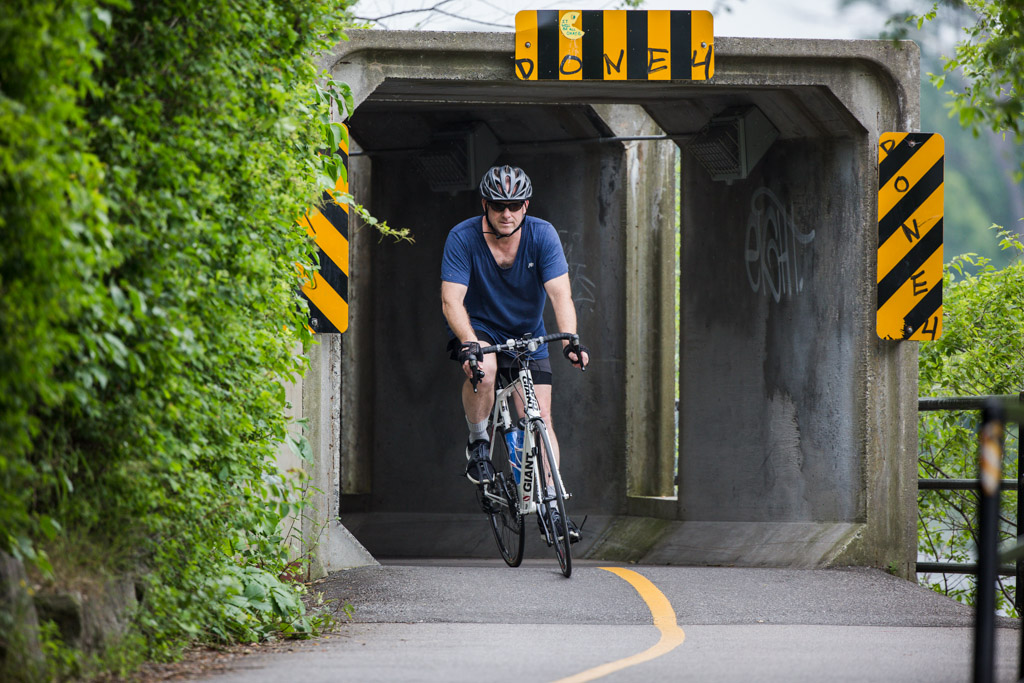
5DMKIII 1/800th, f/4.0 ISO 500, 371mm
Sports shooters, including motorsports, and anyone else who needs the reach over a 70-200, will likely already have this lens on order. The ability to zoom in and out of fast moving subjects will allow for better framing and more “hits” when shooting in these challenging environments. It may be trickier to use indoors and at close ranges due to the shallower aperture, but outdoor sports like football and baseball will allow someone to cover the whole field with almost a single lens.
Conclusion
If you were to buy Canon’s 600mm f/4 L and the 400mm f/4 L, you’d be getting pretty close to $20,000 worth of glass. If you were to buy several of the faster primes, that number would double.  If the versatility of a zoom is what you need and f/4 doesn’t bother you (and for many of us, it really doesn’t), then the Canon 200-400 f/4 L IS USM Extender 1.4x is, in itself, a bargain. Quality build and optics and the unique advantage of a built-in 1.4 extender will help keep photographers working with a single lens, yielding them more shots, more keepers, and better work.
Pros
  • Versatility of a zoom
  • Extra versatility of a built-in extender
  • Quality build and top-of-the line glass
  • Cost is in-line with the value when considering purchasing all primes.
Cons
  • Heavy as hell
  • Conspicuous: everyone will know this lens is worth money
  • Cost of a small car

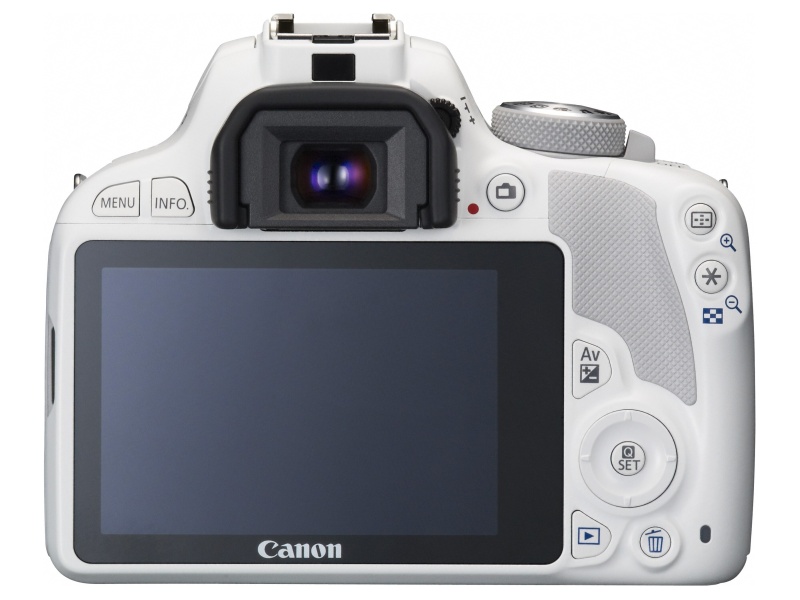
Canon EOS Rebel SL1/Kiss X7 in White

Isn’t she pretty?
Below are some images of the new Canon EOS X7 in white. I personally would like a white 40mm f/2.8 STM!
All the specs of the camera are the same, we’re just talking a new paint job here.
Canon EOS SL1/X7 in White

Zeiss 15mm f/2.8 Distagon T* ZE Lens Review

Zeiss 15mm f/2.8 Distagon T* ZE Lens Review


The Zeiss 15mm f/2.8 Distagon T* ZE Lens is, arguably, the best ultra-wide angle landscape lens available and is a great choice for architecture photography. This manual-focus-only lens is very sharp from the center fully into the corners of even full frame sensors. Operating like a precision instrument, the Zeiss 15 is built to last for generations. This lens has become my go-to lens for critical ultra-wide angle landscape needs.
Zeiss 15mm f/2.8 Distagon T* ZE Lens on Canon EOS 1Ds Mark III - Top View
I have in my hands the third Zeiss 15mm f/2.8 Distagon T* ZE Lens I have used. The first two lenses were sent to me for evaluation with a return required. The return part became too hard for me and the third one has become a permanent part of my kit. Despite the ZE 15's high price and having the full range of Canon options available to me, the first two Zeiss samples convinced me to buy my own ZE 15. It's that good.
The 15mm Focal Length
This lens is not restricted to landscape and architectural uses, but ... the full frame 15mm focal length is most commonly used for these purposes. Here I take you to the reward of a 2,500' (762m) climb – a great view and a large balanced granite rock on Old Rag Mountain in Shenandoah National Park.
Balanced Rock on Old Rag Mountain
The top of Old Rag Mountain provides an exceptional view, but the far away subjects in such views are not necessarily photogenic due to haze and lack of contrasting and/or interesting details. This particular mountain is so high above the distant surroundings that sky and foreground become the primary available subjects. The clear blue sky was beautiful, but you don't need a lot of it in the frame. So, boulders quickly became favored by me. The Zeiss ZE 15mm Lens allowed me to move in very close to the large granite boulders, making them large in the frame relative to the other far more distant objects. Blue sky extending to a level framing position takes care of communicating the height.
The Ultra-Wide Angle Composition Challenge
Getting a good 15mm composition is not hard, but composing great 15mm images can be very challenging. One such challenge is that this lens is so wide that people can get into your frame without even knowing it. I've had even conscientious photographers walk right into my 15mm frame and setup their tripods without even suspecting that they were now part of my composition. But people are not the biggest 15mm composition challenge.
More difficult is finding a scene that provides an attractive background throughout the wide 110° diagonal angle of view (100° horizontal, 76° Vertical). Envision a right angle (such as the corner of your smartphone) placed to your eye. The sides of that angle are only delineating 90°, so you'll need to envision another 5° of view on each side of that angle to realize the ZE 15's 100° horizontal AOV (Angle of View). Add 10° to each side for the diagonal AOV. The 15mm lens' 76° vertical AOV is greater than a 24mm lens' 74° horizontal angle of view.
Backgrounds fulfilling this requirement are in much shorter supply than narrower AOV backgrounds needed from, for example, a 200mm lens. Adding to the challenge is that 15mm OOF (Out of Focus) backgrounds are not magnified in the frame nearly as much as longer focal length OOF backgrounds are. Objects in a 15mm background generally remain identifiable even when wide apertures and short focus distances are used. Here is an example:
Zeiss 15mm f/2.8 Distagon T* ZE Lens Maximum Background Blur
The image above was captured at near MFD (Minimum Focus Distance) with a wide open f/2.8 aperture for the shallowest DOF (Depth of Field) this lens can produce. Shown above is the maximum background blur possible from a 15mm f/2.8 lens, yet the background objects are not hard to identify. Again, finding a pleasing background for a 110° diagonal AOV can be challenging.
For great 15mm compositions, you generally want an attractive close subject to emphasize in a composition that hopefully includes an at-least-as attractive background. That close subject will be emphasized in size due to perspective – the distance from the lens to the close subject will be very short relative to the background objects. Notice the size of the little flower relative to the far larger in real life dog in the background. And you can keep moving closer to increase that emphasis without significantly affecting what is in the background and the state of focus of that background.
Alternatively, skip the complication of panorama capture and stitching techniques. If you don't need to print longer or higher than you DSLR has native resolution for, simply shoot with a wide angle and crop to the aspect ratio you like. How about a Canon EOS 5D Mark III-captured single-frame wide-format image of the Manhattan skyline?
15mm Single Frame Panorama Crop
Notice how straight the buildings are in this example? Shooting level to the horizon is key to this result as converging lines come into play when shooting upward or downward. Envision the same crop removed from the following sample picture.
New York City Skyline
The buildings appear to be leaning strongly outward. If the camera would have been angled downward even more, the buildings would appear to have an even stronger lean. If the camera were angled upward with the skyline low in the frame, the buildings would appear to be leaning inward. If this effect is not desired in your images, shoot with a level camera and crop any unwanted foreground and/or background from your images.
Using the converging line principal to your advantage is also possible. Shooting upward into trees is one common use of this positive use of converging lines.
Converging Lines
Because of this same principle, you will want to keep your living subjects out of the distorting corners of the frame. They will appear to be stretched toward the frame corners. And because a close focus distance provides an unflattering perspective for noses, full body and environmental portraits are the best portrait use for this lens.
There is, of course, nothing wrong with a 15mm composition that simply captures a very wide view of the scene in front of you. And at 15mm, it is not hard to keep the entire frame in sharp focus even at apertures not too narrow to be strongly effected by diffraction. A wide AOV is mandatory when shooting in tight spaces.
While 15mm composition is challenging, when the dust settles and you pull off a great 15mm composition, the results will be worth celebrating. These images will likely become your portfolio favorites.
A 15mm lens on an APS-C/1.6x format DSLR delivers an angle of view similar to a 24mm lens on a full frame body. And full frame 24mm AOV is an even more-commonly used focal length/AOV for landscape photography and other more-general purpose uses. Composing great 24mm images is easier than composing great 15mm images.
If the 15mm focal length works for you, definitely keep reading.
Zeiss 15mm f/2.8 Distagon T* ZE Lens on Canon EOS 1Ds Mark III on Tripod
The f/2.8 Max Aperture
The 15mm focal length is going to see significant landscape and architecture photography use including interiors. I'm sure the grand church interior wedding photo will be one such shot this lens sees use for. With an f/2.8 aperture, stopping subject motion (such as the wedding party) in low light is a capability this lens has. Especially since that action will typically cover only a small area of the sensor.
Fast action at frame-filling subject distances might best be avoided for safety reasons. Remember that the subject is MUCH closer than it appears through the viewfinder.
Riderless Horse Jumping
Better yet, place this lens and a camera on a tripod/stand and fire it using PocketWizards or another remote control method to capture starting line, finish line and other action. Or, capture a close perspective of the bouquet toss at your next wedding.
The minimum shutter speed required for sharp handheld photos is based on the rate at which a subject is moving across the pixels on the imaging sensor. That movement can be subject-caused, or it can be the photographer's motion (in the form of camera shake). Because of the wide AOV, subjects quickly become small with distance and the movement of such covers fewer pixels. Thus, this lens can often be handheld at relatively low shutter speeds which means in low light or with narrow apertures.
This review's aperture comparison is brought to you courtesy of the annual fall destruction of the Carnathan kitchen, AKA cookie production.
Zeiss 15mm f/2.8 Distagon T* ZE Lens Aperture Comparison
The blue apple (I think that is what it is) with little silver balls is the point of focus. The full size 5D Mark III images show stronger blur (the blur is enlarged), but as previously discussed, objects are identifiable throughout the frame even at f/2.8. Note that the f/2.8 image is darker due to vignetting – I'll discuss this below.
Image Quality
One of the most impressive features of the Zeiss 15mm f/2.8 Distagon T* ZE Lens is the sharpness it delivers. I can easily say that this is the sharpest rectilinear 15mm prime lens I've ever used. Of course, this is probably the only 15mm rectilinear DSLR lens available to date. But, I can open this statement up to include all less-than-17mm lenses I've used with perhaps an exception I'll talk about later in the review.
Even at a wide open f/2.8 aperture, Zeiss 15mm f/2.8 Distagon T* ZE Lens results are sharp. Extreme full frame corners are good at f/2.8, but become really impressive by f/8. Stopping down makes little difference in image sharpness within most of the plane of sharp focus.
A much more noticeable effect of stopping down (selecting a narrower aperture) is decreased vignetting, which noticeably improves the appearance of sharpness in the corners (moving them to the right in the tone curve). With 4.5 stops of vignetting in the corners at f/2.8, you would expect to see very dark corners when looking at an entire picture. However, the fall-off pattern is very gradual and the shading is well disguised. Comparing an f/2.8 corner to an f/5.6 corner brings the difference to light. About 2.5 stops of shading remains at f/4 and approximately 1.6 stops remains from f/5.6 through f/16. Use the site's vignetting tool or the aperture comparison to see the corner shading.
A touch of CA (Chromatic Aberration) is visible in the periphery of the full frame image circle when areas of strong contrast (white on black for example) are present.
With an angle of view this wide, it is not hard to get bright lights (including the sun) in the frame. Fortunately, the ZE 15 resists flare very well. With the sun in the corner of the frame, some flare effects will be seen, but the amount is relatively mild.
Distortion (barrel or pincushion), is never a desirable trait of a lens, but it is a very common one. The Zeiss ZE 15 has a small amount of standard barrel distortion (as opposed to wave/mustache distortion). Though it is a destructive process, this barrel distortion can easily be corrected in software. None of my ZE 15 images to date have needed correction applied.
Because getting a background blur at stopped down apertures is a challenge, the quality of that blur is of lower concern with this lens. But, the blur quality, aided by 9 aperture blades, is there if you can coax it out. Here is a full size f/5.6 example using a near MFD focus distance.
Zeiss 15mm f/2.8 Distagon T* ZE Lens Bokeh
OOF specular highlights remain rounded and, though slightly brighter on the perimeter, do not have a harsh edge.
With a wide angle of view and a wide aperture, this is a lens you are going to want to aim at the night sky. Most lenses exhibit some coma and stars on a clear night bring this attribute out perhaps better than any other subject. Following is a crop from the top right corner of a vertically-oriented f/2.8 star photo. The stars in all four corners show a similar stretching (sharp contrast transitions towards the center, soft contrast transitions outward) to their particular corner.
Zeiss 15mm f/2.8 Distagon T* ZE Lens Coma
The above 5D Mark III-captured ISO 3200 image was not noise-reduced – and happens to contain a meteorite as a bonus. The center of the frame shot confirms that star trails are not responsible for the stretching effect. This amount of coma is not unusual and has not prevented me from using this lens for night sky photography.
An interesting image quality note is that my Canon EF 14mm f/2.8 L II USM Lens produces images 1/2 to 2/3 stops brighter than the ZE 15 using identical settings under a clear sky.
As an overall package, the image quality that the Zeiss 15mm f/2.8 Distagon T* ZE Lens delivers is top-of-the-line.
Zeiss 15mm f/2.8 Distagon T* ZE Lens Angle View
Manual Focusing
Like all of the other Zeiss ZE lenses, this is a manual-focus-only lens. Fortunately, Zeiss makes some of the nicest manual focus systems available (one of the reasons their lens are commonly selected for motion picture recording) and the ZE 15 is yet another example of this excellence.
The full rotation of the manual focus ring is only 55°, but this amount is quite adequate for very precise focusing. Infinity focusing comes quickly with a 15mm lens. The focus ring is very solid and extremely smooth with no play or wobble. Rotational resistance required for adjustment is a bit light for my set-and-forget uses, but it is ideal for active use. One of my daughter’s pony tail holders stretched over the crease between the hood and the ring increases the resistance when I desire this.
Infinity focus is, as usual for Zeiss ZE lenses, a hard stop. I have found that ideal focus on stars (as close to infinity as most of us get) is just slightly shy hard the hard stop, but the DOF of this lens at narrow apertures and typical shooting distances allows the hard stop to work for quick focusing.
If your focusing needs are not varying much and a narrow aperture is in use, you can set focus (to the hyperfocal distance) and forget it. Figure out where your personal focus sweet spot is and remember the setting for future use (and for visual in-focus confirmation). For example, I often set the focus distance so that the line is set to a specific point in the infinity symbol and I know that everything in the frame will in focus at my favorite landscape aperture, f/11. A really close subject included in the frame will cause me to veer from this one-setting-fits-all approach.
The focus ring takes up much of the lens barrel and is where you would ideally hold the lens when shooting handheld. This practice can lead to accidental change of the focus distance setting. I have found that grasping the lens behind the focus ring with my thumb and first finger while placing my last finger on the base of the integral lens hood works well for supporting the lens without touching the focus ring.
I find manual focusing with today's stock DSLR camera focusing screens difficult. But, with the generally deep DOF this lens provides at the distances this lens is commonly used at, I'm doing OK with manually focusing this lens. Fully magnified Live View manual focusing remains my preference for all manual focus needs.
This lens does not extend and the front element does not rotate with focusing. Subjects do not change size as they go into and out of focus, though as discussed, getting a meaningful background blur requires a short focus distance. That subject size does not change with focusing makes focus stacking techniques more easily accommodated. As usual, Zeiss provides a detailed DOF scale etched into the lens barrel and focus distances are etched into the focus ring.
This is not a close-up lens. Look elsewhere if this is a capability you need. The 9.8" (250mm) MFD (Minimum Focus Distance) yields a very low 0.11x maximum magnification.
ModelMFDMM
Canon EF 8-15mm f/4 L USM Fisheye Lens5.9"(150mm)0.39x
Canon EF-S 10-22mm f/3.5-4.5 USM Lens9.4"(240mm)0.17x
Nikon 14-24mm f/2.8G AF-S Lens11.0"(280mm)0.15x
Canon EF 14mm f/2.8 L II USM Lens7.9"(200mm)0.15x
Zeiss 15mm f/2.8 Distagon T* ZE Lens9.8"(250mm)0.11x
Canon EF-S 15-85mm f/3.5-5.6 IS USM Lens13.8"(350mm)0.21x
Canon EF 16-35mm f/2.8 L II USM Lens11.0"(280mm)0.22x
Canon EF 17-40mm f/4.0 L USM Lens11.0"(280mm)0.25x
Canon TS-E 17mm f/4 L Tilt-Shift Lens9.8"(250mm)0.14x
Zeiss 18mm f/3.5 Distagon T* ZE Lens11.8"(300mm)0.09x
I mounted a Canon EF 12mm Extension Tube II behind the ZE 15, but the minimum focus distance is so short that the combo is unusable.
You will be able to get a nice perspective on subjects at this lens' MFD, but again, subject magnification is not a strength of this lens. Perhaps the Canon EF 8-15mm f/4 L USM Fisheye Lens would be a better choice for your dramatic perspective needs.
Zeiss 15mm f/2.8 Distagon T* ZE Lens on Canon EOS 1Ds Mark III - Front View
Build Quality & Features
This lens, like all of the other Zeiss ZE Lenses, has build quality worth raving about. The precision all-metal construction seems ready to last for generations.
Zeiss 15mm f/2.8 Distagon T* ZE Lens Product Images
Select View:  MFD |    w/ Hood:  MFD |    Rotated        Compare >
A narrow, grooved, fixed section near the lens mount provides grip for mounting/unmounting the lens – or for holding the lens without changing the focus. The "narrow" descriptor holds more limitation for the latter use. The also-metal focus ring ribs provide a sure grip on the wider section of the lens. The focus ring is the only moving exterior part of this lens – this lens has no switches and no reason to have a switch.
If the diameter of this lens stopped with the focus ring, it would be a rather compact lens. However, the lens flares outward significantly to house the large front lens element. The result is a lens that is comfortable to hold and use, but is wide in the front.
As far as weight is concerned, I can't say that I've ever heard Zeiss say that saving weight was worth sacrificing any aspect of the ZE lens quality including strength. And this rock solid lens ranks in the upper weight class among its peers.
ModelWeightDimensions w/o HoodFilterYear 
Canon EF 8-15mm f/4 L USM Fisheye Lens19.1 oz(540g)3.1 x 3.3"(78.5 x 83mm)n/a2010
Canon EF-S 10-22mm f/3.5-4.5 USM Lens13.6 oz(385g)3.3 x 3.5"(84 x 90mm)77mm2004
Nikon 14-24mm f/2.8G AF-S Lens34.2 oz(969g)3.9 x 5.2"(98 x 131.5mm)n/a2007
Canon EF 14mm f/2.8 L II USM Lens22.8 oz(645g)3.1 x 3.7"(80 x 94mm)n/a2007
Zeiss 15mm f/2.8 Distagon T* ZE Lens28.9 oz(820g)4.1 x 5.3"(103 x 135mm)95mm2012
Canon EF-S 15-85mm f/3.5-5.6 IS USM Lens20.3 oz(575g)3.2 x 3.4"(81.6 x 87.5mm)72mm2009
Canon EF 16-35mm f/2.8 L II USM Lens22.6 oz(640g)3.5 x 4.4"(88.5 x 111.6mm)82mm2007
Canon EF 17-40mm f/4.0 L USM Lens16.8 oz(475g)3.3 x 3.8"(84 x 97mm)77mm2003
Canon TS-E 17mm f/4 L Tilt-Shift Lens28.9 oz(820g)3.5 x 4.2"(88.9 x 106.9mm)n/a2009
Zeiss 18mm f/3.5 Distagon T* ZE Lens16.6 oz(470g)3.4 x 3.3"(87 x 84mm)82mm2010
I need to point out that the measurements above are manufacturer specs and that our own measurements (that include the entire lens mount) differ significantly with the Nikon 14-24 and Zeiss 15 lens specs. We measured the Nikon to be 0.4" (10.2mm) longer than Nikon spec and the Zeiss measures .41" (10.6mm) shorter than its spec. While the Nikon weight spec is near our measurement, the Zeiss actually weighs 2.6 oz (75g) less than the spec we were given. The reality is that the Zeiss 15 is 8.1 oz (230g) lighter and 0.68" (17.3mm) shorter than the Nikon. This discrepancy needed highlighting for the lens comparison images found later in the review to make sense.
For many more comparisons (with measured results), view the complete Zeiss 15mm f/2.8 Distagon T* ZE Lens Specifications using the site's Lens Spec tool.
Zeiss 15mm f/2.8 Distagon T* ZE Lens on Canon EOS 1Ds Mark III - Angle View
Filters
I need to draw your attention to the filter size column in the table above. There are a lot of n/a (not applicable) listings there. And if you remove the APS-C-only lenses, there are only a pair of Canon zoom lenses and a pair of Zeiss prime lenses remaining.
Zeiss 15mm f/2.8 Distagon T* ZE Lens with 95mm Filter
If you are a serious landscape photographer (and many considering the purchase of this lens are), you probably can't live without a circular polarizer filter. Finding a full frame-compatible ultra-wide angle lens that accepts standard threaded filters is a challenge. There are few prime lenses wider than 20mm that accept such filters.
Ultra-wide angle prime lenses (and a popular zoom lens) are dominated by convex-objective-lens designs that do not natively accept such filters. Very large third-party adapters are available for the most popular of such lenses, but these adapters require inconvenient-to-take-with-you plate-sized filters (145mm for example) in addition to the bulk of the special filter holder itself. The Zeiss 15mm f/2.8 Distagon T* ZE Lens meets the standard filter compatibility challenge. The 95mm filters it accepts are not small, but they very manageable.
The 95mm Ultra-Wide Angle Filter Challenge
Selecting the right 95mm filters for the Zeiss 15 requires some attention. With an ultra-wide angle of view, filter rings can easily interfere with the full frame image circle of this lens. Physical vignetting is an issue that needs to be addressed.
At review time, my preferred filter brand, B+W, is not offering their slim XS-PRO circular polarizer filter line in the 95mm thread diameter. The standard B+W 95mm MRC Circular Polarizer Filter ring depth is 8.3mm (not including threads). And this depth results in hard vignetting in the corners as seen below.
Zeiss 15mm f/2.8 Distagon T* ZE Lens Filter Vignetting
Even at the narrow f/11 aperture used for the above example, the 8.3mm filter shows noticeably darkened corners. You can crop the corners off, but then you lose some of the focal length you bought this lens for in the first place. You can try to fix the corners using a clone/stamp or other tool available to you, but ... this process is sometimes very difficult (especially with a gradient present in the corner) and in those cases, time consuming.
The better choice is to use only slim filters. Your first reaction to a slim filter recommendation is probably concern about the slip-on lens cap that is typically supplied with them. That the cap will not stay attached is the concern. There are no worries here as the ZE 15's lens cap slides right over the filter (more about this to come).
The top-of-the-line 95mm Heliopan SH-PMC Slim Circular Polarizer Filter measures 5mm (sans threads) and adds no vignetting. Please be seated before looking at the price of this fine piece of glass fitted in a brass ring. One important factor in my selection of this filter is that pressing the rotating portion of the ring toward the lens increases friction that makes filter removable easier. I'll explain why this is an especially important feature for this lens in a moment. The Heliopan had the most neutral color transmission of the high end filters I tested and that there was no increased flare with sun-in-the-corner of the frame sealed the deal on this optically-excellent filter.
Another great slim CPOL filter choice is the The Marumi 95mm Super DHG Circular Filter. The actual image quality delivered by this filter is very, very close to that of the Heliopan and the price is far more palatable. The aluminum-ringed Marumi delivers image quality including polarizer effect and flare results very similar to the Heliopan.
Note that the review-time-current Zeiss 95mm CPOL filter is not slim enough to avoid vignetting, but you should be hearing about a new slim version this year (2013). With the Zeiss T* multicoating, I expect this filter to be a great choice.
The Ultra-Wide Angle Circular Polarizer Unevenness
As you can see in the above example, CPOL filters used at 15mm are going to show unevenness in skies. You will sometimes want to avoid this use, but I still often prefer partially-darkened skies for the effect. I will include examples in the sample pictures for this lens. Regardless of your taste for unevenly darkened skies, the difference these filters make in other uses, especially landscape photography, makes them indispensable. Here are two comparison examples:
Zeiss 15mm Lens With and Without Circular Polarizer Filter
Watch the CPOL filter bring out the rich colors in the moss, water and foliage by cutting the reflections on them.
I should clarify that all of the images in the above comparison were captured with the CPOL filter in place. The filter was adjusted to allow most of the reflections to show in the "Without" example - as would be the similar case if the filter were not installed. Otherwise, both images in each comparison were processed identically. The with-filter improvements appear much more significant in the full sized images.
The Built In Hood
Like the ultra-wide angle prime lenses with convex front lens elements, this lens has a built-in lens hood. The good news is that the hood is always there to block bright light from hitting the front lens element and to protect the same. Just that small amount of lens hood protrusion is enough to keep rain from hitting the front element (or a CPOL filter attached to it) in some situations (first hand experience) when shooting in horizontal orientation. I should note here that this lens is not weather sealed. And I will also note that water drops or other debris on the front lens element or filter are quite visible in images captured at this angle of view. And removing the effects of these drops from images rivals removing flare – it can be a very difficult process.
Yes, it accepts filters, but ... don't get one stuck! While the most-recessed portions of the lens hood provide near hood-less ease of filter adjustment access, the non-recessed portions of the hood make it extremely difficult to remove stuck filters. You cannot get a filter wrench around the filter. Be aware of this before your over tighten your filter on this lens. I have a general over-tightening problem, and a stuck filter was a dilemma for me. And I am thankful that the Heliopan filter I selected could be removed by pressing toward the lens while twisting.
Installing and uninstalling these very-large-sized filters takes a bit of time since the available filter opening restricts you to short turns of the filter. As always, use care when installing and removing filters as filter threads can scratch a front lens element if misdirected.
The Lens Cap
When a lens has a built-in lens hood, that lens usually has a lens cap that wraps around that hood. So it is no surprise that the Zeiss 15 gets a metal slip-on lens cap. This cap style tends to be problematic in that it does not remain in place very well, but the quality metal ZE 15 cap has been working nicely for me. A thin layer of padding material protects the lens hood from the cap and adds the right amount of friction to hold the cap in place. A nice feature is that the cap slides over the top of any filter you have installed. Here it is:
Zeiss 15mm f/2.8 Distagon T* ZE Lens Lens Cap
You are on your own to find a case for the Zeiss ZE 15 as none is included in the box.
Let's take a visual look at some competing lenses.
Ultra-Wide Angle Lenses
Positioned above from left to right in their fully retracted positions are the following lenses:
Zeiss 18mm f/3.5 Distagon T* ZE Lens
Canon EF 14mm f/2.8 L II USM Lens
Canon TS-E 17mm f/4 L Tilt-Shift Lens
Zeiss 15mm f/2.8 Distagon T* ZE Lens
Canon EF 16-35mm f/2.8 L II USM Lens
Nikon 14-24mm f/2.8G AF-S Lens
The same lenses are shown below in their fully extended states with their lens hoods in place.
Ultra-Wide Angle Lenses with Hoods
No, your eyes are not failing you. Only the Canon 16-35 L II and Zeiss 18 have removable lens hoods.
As I transition this review to a look at the models that compete most with the Zeiss ZE 15, I want to share a focal length comparison. At 400mm, no one would care about the difference 1mm makes as the relative change is tiny. However, the difference each mm of focal length change makes at ultra-wide angles is very noticeable.
Zeiss 15mm f/2.8 Distagon T* ZE Lens Focal Length Range Example
The Ultra-Wide Angle Landscape Lens Dilemma
I am on a continuous quest for the ultimate landscape lenses, but contend that the perfect ultra-wide angle landscape lens does not yet exist. There are shortcomings to every choice. Let me talk about some of the contenders.
Canon EF 14mm f/2.8 L II USM Lens
First up is Canon's widest rectilinear prime lens, the 14 L II. The modestly lighter and more compact Canon 14 L II is an excellent lens with image quality rivaling the Zeiss ZE 15. When stopped down, these two lenses deliver similar image sharpness. The 14 L II trails the Zeiss 15 slightly in corner sharpness, flare and slightly in bokeh (6 blades vs 9). The Canon has slightly more CA, but it has slightly less distortion, less vignetting, a wider focal length and AF to its advantage. The Canon is weather sealed though the front element is not be completely sealed. A filter is required for complete weather sealing, but the Canon does not accept standard threaded filters. Inability to accept threaded filters without a large aftermarket adapter, in my opinion, is the Canon 14 L II's major fault for landscape use.
Canon TS-E 17mm f/4 L Tilt-Shift Lens
Canon's next narrower focal length prime lens is the TS-E 17 L. This is another lens that delivers very impressive image quality. The TS-E 17 has only an f/4 max aperture, but from f/5.6 and narrower, it at least matches the Zeiss 15 in sharpness. The TS-E 17 L and Zeiss 15 have a similar size & weight and the two lenses share manual focus characteristics. The TS-E 17 has less vignetting, has no distortion and has tilt/shift movement capabilities to its advantage. The 17mm focal length is not as wide as the 15mm focal length, but the convex front lens element that is unable to accept standard threaded filters (or even a lens hood) is the Canon's biggest shortcoming for landscape use.
Other Canon Prime Lenses
Canon's next narrower prime lens is 24mm. While all 3 of Canon's 24mm lenses are superb, that focal length moves these lenses into a different category.
Canon EF 16-35mm f/2.8 L II USM Lens/Canon EF 17-40mm f/4.0 L USM Lens
Canon makes a pair of excellent full frame zoom lenses that include 16mm and 17mm wide angles with threaded filter compatibility. The zoom lenses offer a big advantage of having a range of focal lengths instantly available along with autofocus. Both zooms deliver remarkably sharp image quality, but the Zeiss is sharper than either – especially at wider apertures and in full frame corners. A big downside is that the zoom lenses have strong barrel distortion at their widest focal lengths. It will not be hard to see a flat horizon bow outward at the edge of the 16/17mm frame. The Canon zooms are lighter and have weather sealing to their advantage. The 16-35 L II is a lens I frequently use – it remains a standard in my kit.
Zeiss 18mm f/3.5 Distagon T* ZE Lens
The ZE 15mm lens is the widest Canon/Nikon mount lens Zeiss makes. The next-longer Zeiss lens is 18mm, which also happens to be the second widest prime lens that accepts standard front filters. The 18 is smaller and lighter than the 15 and also delivers very good image sharpness. The 15 shows less flare and less CA. The 18 exhibits wave/mustache distortion and 18mm is, of course, not nearly as wide as 15mm.
Nikon 14-24mm f/2.8G AF-S Lens
Earlier in the review, I mentioned a lens that rivals the ZE 15 for sharpness at 15mm and the Nikon 14-24 is that lens. The Nikon 14-24mm f/2.8 is a highly-loved lens, primarily due to the image sharpness it delivers. It is so-loved that many have used an adaptor to make this lens usable on Canon DSLR cameras. I personally find the very strong barrel distortion this lens delivers at wider angles to be unsavory for many uses. Yes, you can correct the distortion, but this process is destructive to image quality and may result in less angle of view than the image started with. Zooming to a longer focal length results in lower distortion results from the 14-24, but distortion does not equal the Zeiss 15 until about 18mm.
Again, the Nikon 14-24mm will rival the Zeiss in sharpness at 15mm and has a range of focal lengths and AF to its advantage. The Nikon has stronger CA and is larger/heavier than the Zeiss 15. Once again, with its convex objective lens, this lens does not support standard threaded filters without a large aftermarket adapter.
APS-C Format Options
APS-C format DSLR camera owners have many more options for getting to 15mm or wider than full frame owners. But, the ZE arguably delivers better image quality than all of them.
The Price
In the above comparisons, I did not mention price. Unfortunately, price is going to be the biggest limitation to this lens' popularity. The Zeiss 15mm f/2.8 Distagon T* ZE Lens is the most expensive ultra-wide angle lens I've used, but obviously (since I now own one), I think it is the best-available ultra-wide angle landscape lens, and that it is worth the price. Serious bird and wildlife photographers pay far more for their big lenses, and you are not likely any less concerned about image quality than they are. The price is justifiable, but being realistic, affordability will be the bigger hurdle for many.
Zeiss 15mm f/2.8 Distagon T* ZE Lens on Canon EOS 1Ds Mark III - Side View
It is the Best
As I just said, I regard the Zeiss 15mm f/2.8 Distagon T* ZE Lens as the best-available ultra-wide angle landscape lens available. This lens is also an excellent choice for architecture and other confined-space photography. The Zeiss 15mm f/2.8 Distagon T* ZE Lens offers very impressive build quality and excellent prime lens image quality in a made-for-landscape and architecture focal length.

 http://www.the-digital-picture.com